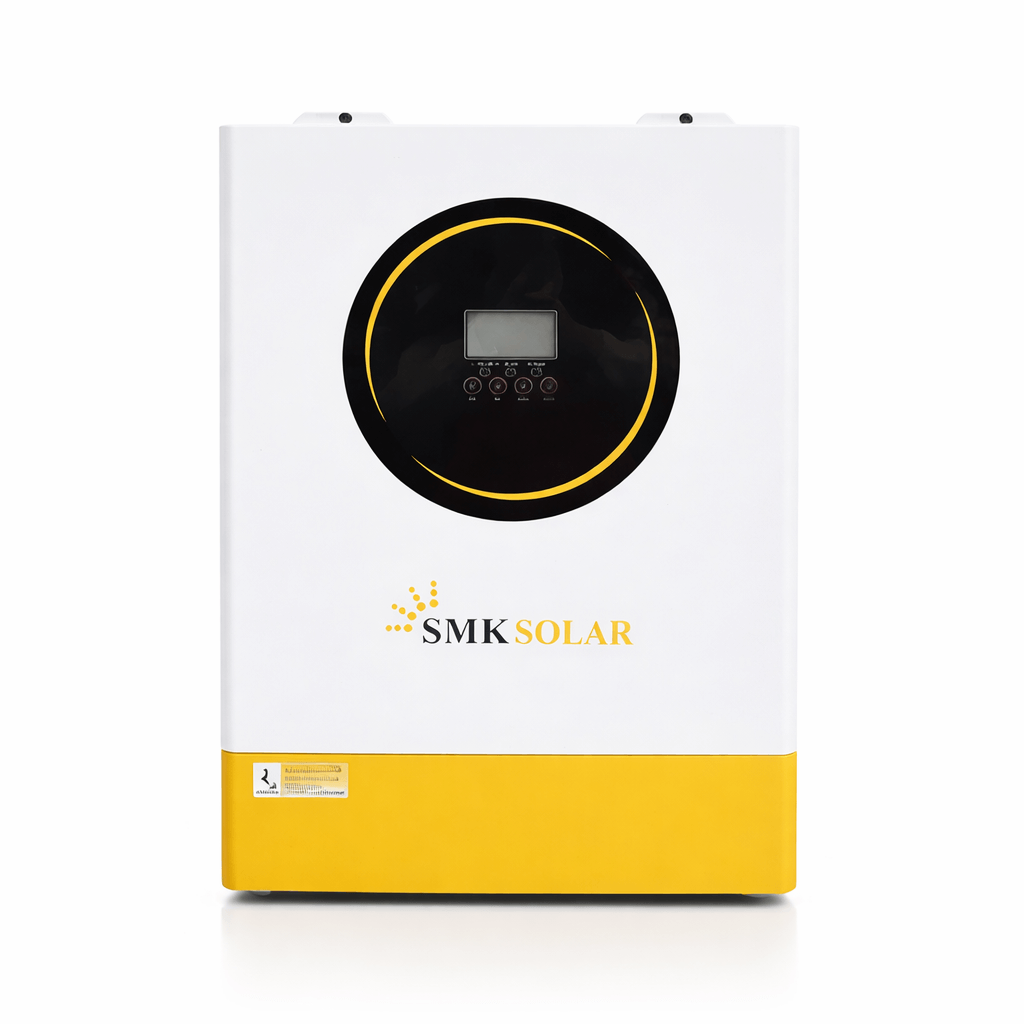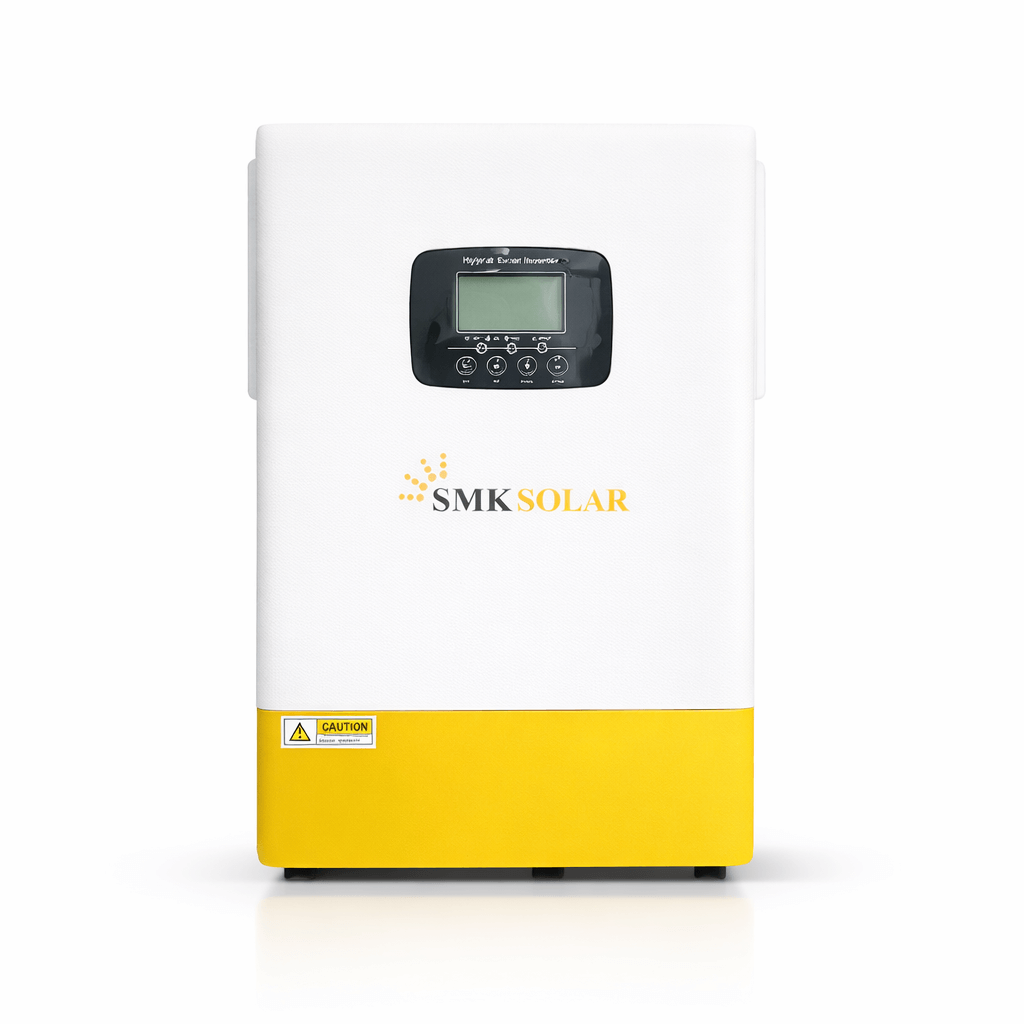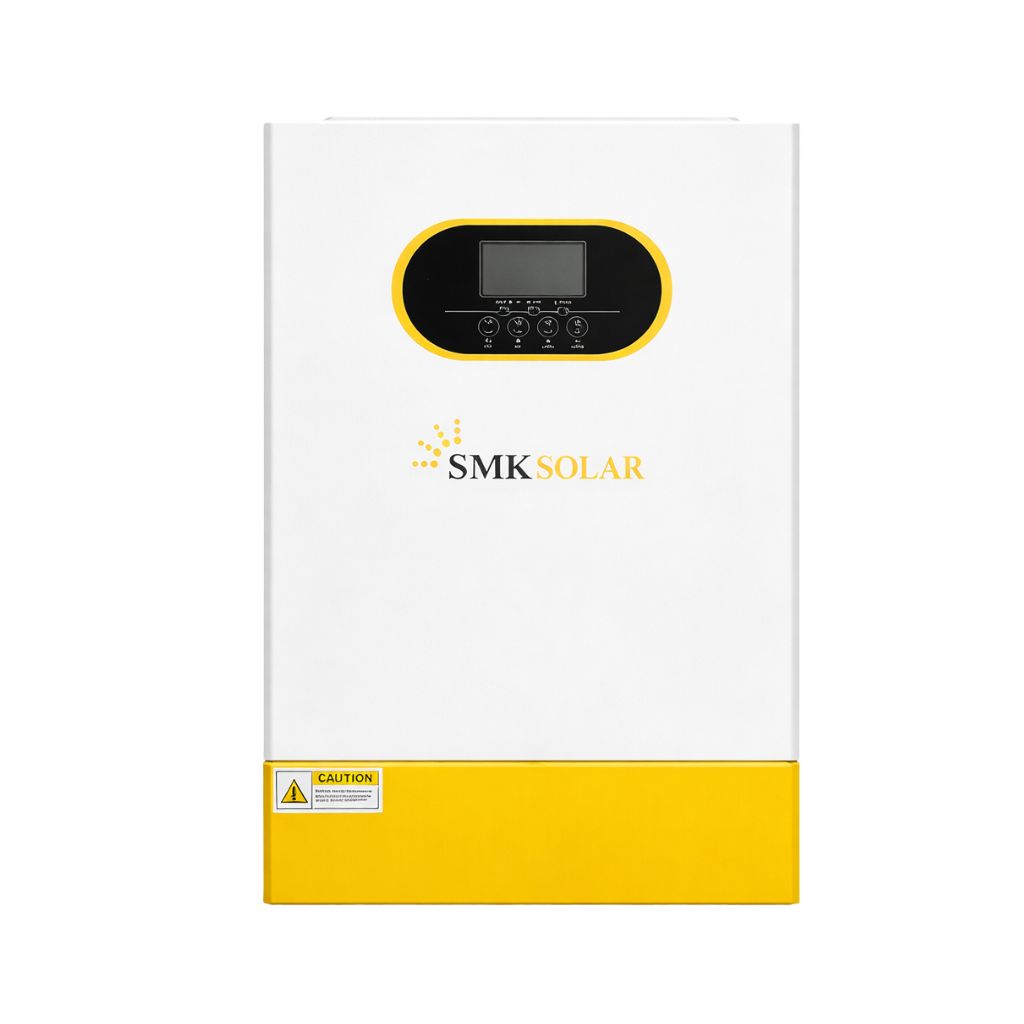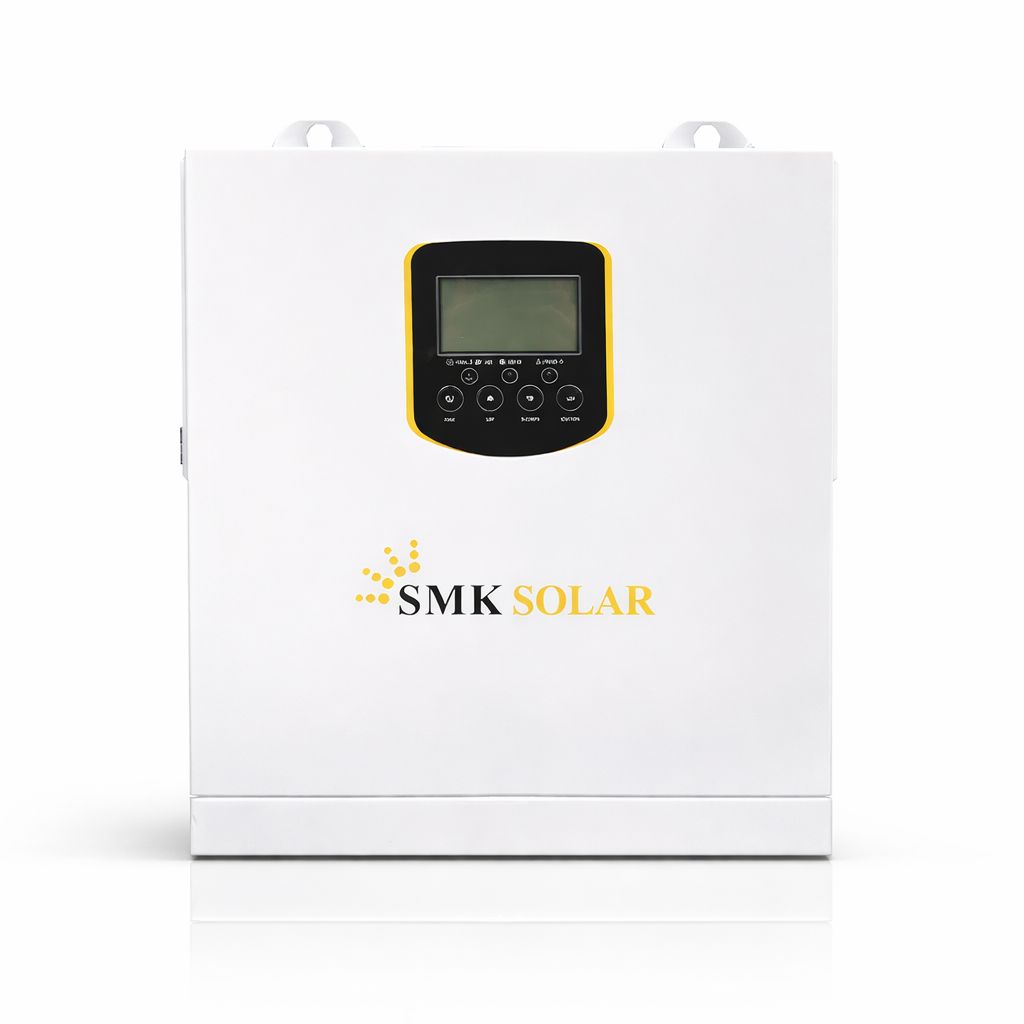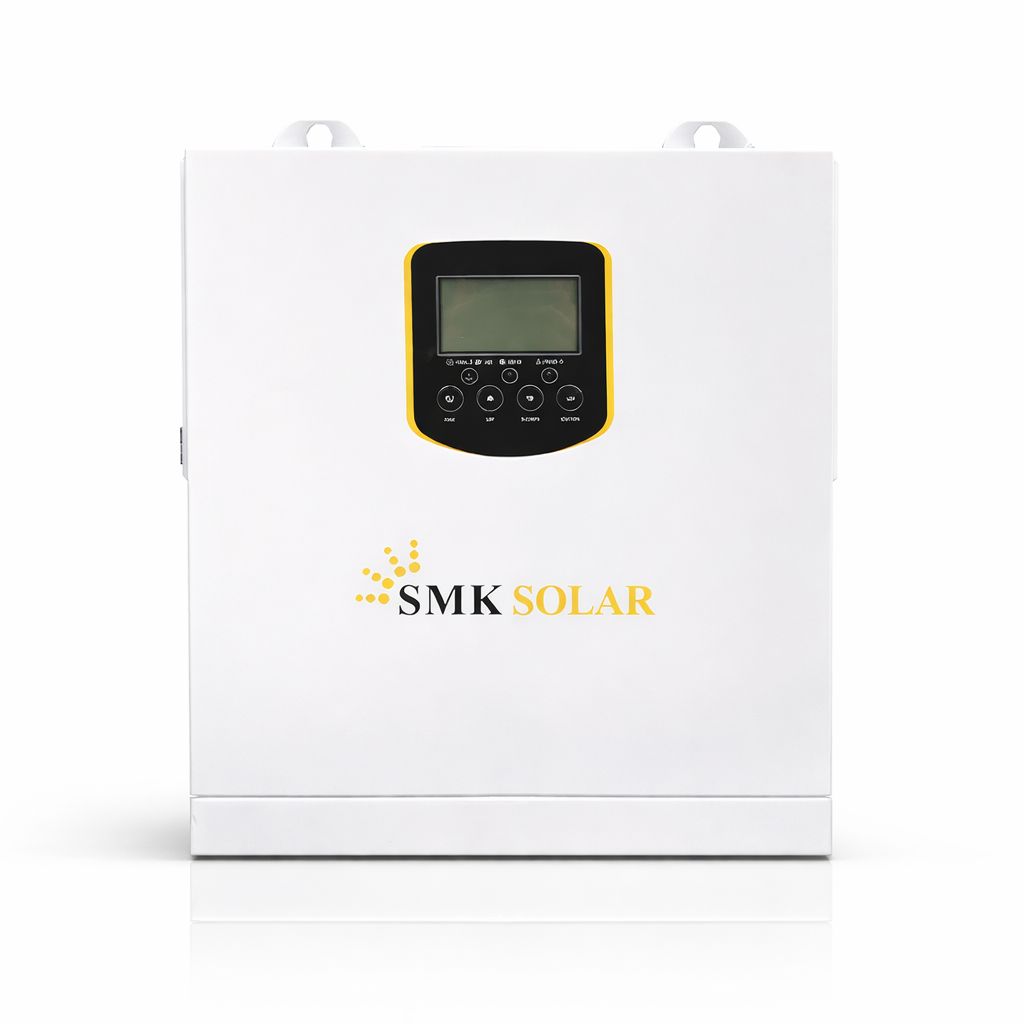
For commercial properties and large homes in Lagos, Nigeria spending between ₦1.5 million and ₦3 million annually on diesel or petrol to keep a 10kVA generator running through daily outages, the cost of doing nothing has become harder to justify than the cost of switching to solar. The EM11000-48L 11kVA Hybrid Inverter is a single-unit 48V system with dual MPPT solar trackers accepting up to 11,000W of panel input, a 22,000VA surge capacity for heavy motor and compressor startups, full LiFePO4 lithium battery communication, and the ability to operate without a battery installed when solar generation alone is sufficient to carry the load. SMK Solar has been designing and delivering complete solar systems for Nigerian homes and businesses since 2016, and the EM11000-48L is our most powerful single-unit inverter — built for the buyer who needs the performance of a commercial generator in a silent, solar-first package.
The EM11000-48L is a 48V hybrid inverter rated at 11kVA — and because it operates at a power factor of 1.0 for standard loads, its 11kVA rating equals 11,000 watts of real, continuous usable power. The kVA figure describes the maximum total electrical load the inverter can manage at any moment; the watts figure is what your appliances actually draw from it. For this unit running typical commercial or large residential loads, those two numbers are identical.
What makes this inverter particularly capable is its dual MPPT solar charge controller — two independent Maximum Power Point Tracking circuits, each accepting up to 5,500W of solar panel input from a separate string. This means panels facing different directions, mounted on different roof sections, or experiencing different shading conditions can each be optimised independently rather than dragging each other down through a single shared circuit. The result is more total energy harvested from the same number of panels compared to a single-MPPT system of equivalent rating.
What “Hybrid” means:
A hybrid inverter actively manages three power sources simultaneously — solar panels, a battery bank, and the national grid — automatically selecting the most available and cost-efficient source at every moment based on the priority setting chosen during installation. During daylight hours with strong sun, solar panels power your loads directly and charge the battery simultaneously. After sunset, the battery carries the load. If the battery runs low and grid supply is present, the inverter draws from NEPA to sustain your appliances and recharge the battery for the next cycle. The EM11000-48L extends this further with batteryless operation — running loads directly from solar output during daylight with no battery installed — and with lithium battery activation from both solar and mains supply, giving maximum commissioning flexibility.
At 11,000W of continuous output and a 22,000VA surge capacity — exactly double the rated output — this inverter is built for loads that would trip any smaller unit:
The EM11000-48L does not support parallel connection, so its 11kVA ceiling is fixed — if your total load now or in the future exceeds 11,000W, a parallelable inverter platform is the appropriate choice rather than this unit. It also requires a 48V battery system — four 12V batteries in series, two 24V batteries in series, or a purpose-built 48V lithium battery — meaning existing smaller battery banks from a previous inverter cannot be reused without full replacement. While this inverter can handle a 0.5HP water pump, borehole pumps above 1HP and industrial three-phase motors fall outside its practical range. Electric cookers, water heaters, and pressing irons remain unsuitable regardless of inverter capacity, as their heating elements draw continuous power that crowds out every other commercial load on the circuit. Our team handles load assessments for every EM11000-48L installation we support — bringing your full appliance and equipment list to that conversation will give you the clearest picture before you invest.
The EM11000-48L operates on a 48V battery system, requiring four 12V batteries wired in series, two 24V batteries in series, or a single 48V lithium battery. It supports LiFePO4 lithium batteries with full RS485 communication — the inverter communicates directly with the battery’s BMS (battery management system, the internal safety circuit governing charging and discharging) to optimize charge precision and protect against overcharge or deep discharge. It can also activate a deeply discharged or new lithium battery from either solar or mains supply, removing the need for a separate activation charger. The EQ charging function maintains lead-acid tubular battery health by periodically balancing cell charge levels — particularly valuable at this capacity level where daily cycling rates are high and cell imbalances develop faster than in smaller residential systems. For a commercial installation running an 8,000–9,000W load daily, battery bank sizing is critical — our team will calculate the correct 48V battery capacity to cover your full load through your longest expected outage window.
The EM11000-48L is not a scaled-up home inverter — it is a commercial-grade energy management system designed to carry the full load of a large Nigerian property through daily outages while charging an 11,000W solar array through two independent MPPT trackers simultaneously.
A commercial property running a 10kVA diesel generator for 10 hours daily at ₦1,500 per litre, consuming roughly 3.5 litres per hour, spends approximately ₦1,916,250 per year on fuel before a single service visit — a figure that grows with every fuel price increase and every extended outage. Replacing that daily runtime with solar-charged battery power through the EM11000-48L, drawing from up to 11,000W of solar panels across two independent MPPT strings, eliminates the majority of that annual cost and typically delivers full system payback within 18–24 months for high-consumption commercial properties in Nigeria.
The EM11000-48L delivers pure sine wave electricity across its full 11,000W output — the smooth, consistent waveform that inverter air conditioners, variable-speed compressors, server equipment, medical devices, and sensitive office electronics are all engineered to receive without stress or degradation. Modified sine wave inverters at this capacity level, occasionally available at lower prices, produce a stepped waveform that causes inverter ACs to draw more current than their rated consumption, shortens compressor and motor lifespan, and can permanently damage server hardware and medical equipment — consequences that compound severely across a full commercial appliance inventory.
The two independent MPPT trackers in the EM11000-48L allow solar panels on different roof sections, different orientations, or different shading profiles to be connected on separate strings and optimised independently — rather than forcing all panels through a single tracker where the weakest string pulls down the output of the strongest. For commercial properties in Lagos and all over Nigeria with complex roof layouts, mixed panel orientations, or partial shading from neighbouring buildings, dual MPPT is the difference between a system that performs on paper and one that delivers its rated output in real conditions every day.
Our team will assess your full commercial load and give you a complete EM11000-48L system specification and cost — including battery sizing and solar array design.
Large commercial property owners in Lagos & the whole of Nigeria running four or more air conditioners, commercial refrigeration, office computing equipment, and full-building lighting simultaneously — the 11,000W continuous output and 22,000VA surge capacity carry that combined load without the inverter ever approaching its ceiling.
Hotel and guesthouse operators in Lagos and Abuja who need to guarantee guests uninterrupted AC, refrigeration, lighting, and WiFi through daily outages, without a generator noise complaint and without a diesel bill that erodes monthly revenue.
Medical clinic and diagnostic centre owners in Benin City and Lagos where power interruptions to refrigerated vaccines, diagnostic equipment, and operating environment AC carry consequences that go directly beyond financial cost — the 10ms PC-mode transfer time means sensitive equipment does not register the source switch.
Office complex managers in Abuja and Lagos Island running server rooms, workstations, CCTV systems, and multiple AC units who need a single inverter capable of carrying the entire electrical load of a multi-floor commercial space without splitting the system across multiple smaller units.
Residents of large estates and luxury homes in Lagos, Abuja, or Kano with five or more bedrooms, multiple living areas, a home gym, home office, and full air conditioning throughout — the EM11000-48L carries that entire load with headroom to spare.
Businesses anywhere in Nigeria where grid supply is absent for 18–22 hours daily and a large diesel generator is the only current alternative — a properly sized EM11000-48L system with a 48V lithium battery bank and 9,000–11,000W of solar panels can cover the full commercial load through the entire outage window on any day with adequate sunlight.
Industrial light users and workshop operators in Kano, Lagos etc. running CNC machines, printing equipment, or small production lines on single-phase supply who need the 22,000VA surge headroom to start heavy motors without tripping the inverter under full load.
Spec | Value |
Model | EM11000-48L |
Capacity | 11,000 VA / 11,000 W |
Parallel Capability | No |
Nominal Input Voltage | 230 VAC |
Acceptable Input Range | 170–280 VAC (PC); 90–280 VAC (Appliances) |
Input Frequency | 50/60 Hz (Auto sensing) |
Battery Voltage | 48 VDC |
Floating Charge Voltage | 54 VDC |
Overcharge Protection | 63 VDC |
Max Discharge Current | 220 A |
Solar Charger Type | Dual MPPT |
Max PV Array Power | 11,000 W (5,500 W × 2 trackers) |
Max PV Open Circuit Voltage | 500 VDC |
MPPT Voltage Range | 60 VDC – 500 VDC |
Max Solar Charge Current | 160 A |
Max AC Charge Current | 120 A |
Output Waveform | Pure Sine Wave |
Power Factor | 1.0 |
Surge Capacity | 22,000 VA |
Transfer Time | 10 ms (PC); 20 ms (Appliances) |
Peak Efficiency | 94% |
Lithium Battery Activation | Yes (by PV or Utility) |
Lithium Battery Communication | Yes (RS485) |
Batteryless Operation | Yes |
EQ Charging Function | Yes |
Output Priority Modes | UTL / SOL / SBU / SUB |
Communication Interface | RS232 / RS485 / Dry-contact |
Environmental Protection | Detachable dust cover |
Dimensions (D × W × H) | 540 × 415 × 122 mm |
Net Weight | 15 kg |
Operating Temperature | -10°C to 55°C |
Warranty | 18 Months |
The EM11000-48L provides 11,000W of continuous output, which covers four 1HP air conditioners, two 1.5HP air conditioners, two full-size refrigerators, two chest freezers, up to 20 LED bulbs, six ceiling fans, three televisions, six laptops or desktops, a server rack, a CCTV system, and a 0.5HP water pump all running at the same time. A combined running load of a typical large commercial property sits between 7,000W and 9,000W — well within the inverter’s continuous ceiling with genuine headroom remaining for startup surges from compressors and motors. Electric cookers, industrial water heaters, and pressing irons are not suitable regardless of how much headroom remains, as their heating elements consume power continuously in ways that interfere with every other load on the circuit.
MPPT stands for Maximum Power Point Tracking — the technology that allows a solar charge controller to continuously adjust how it draws current from panels to extract the maximum available energy at every moment. The EM11000-48L has two independent MPPT trackers, each accepting up to 5,500W of solar input from a separate panel string. This matters for commercial properties because it allows panels on different roof sections — east-facing and west-facing, for example, or a rooftop string and a ground-mounted string — to be tracked and optimised independently. If both strings shared one tracker, the lower-performing string would pull down the output of the better-performing one; with dual MPPT, each string operates at its own peak independently, harvesting more total energy from the same installation.
Yes. The EM11000-48L operates in batteryless mode, running connected loads directly from solar panel output during daylight hours with no battery bank present. This allows commercial buyers to commission the system with panels only and add a 48V battery bank in a second phase when budget allows — without replacing or reconfiguring any existing hardware. At night or during extended cloud cover without a battery, the inverter draws from grid supply if NEPA is available, or suspends output if neither source is present.
The EM11000-48L requires a 48V battery system and supports both LiFePO4 lithium and lead-acid tubular batteries. For a commercial load of 8,000–9,000W running through a 12-hour overnight outage, the battery bank needs to store approximately 96–108kWh of usable energy — which at 48V and typical depth of discharge for lithium translates to a substantial multi-battery bank that our team will size precisely for your specific load and outage window. Lithium batteries are strongly recommended at this scale: their ability to discharge more deeply, charge faster, and last significantly longer than tubular alternatives reduces total cost of ownership over the system’s lifetime, especially when daily cycling rates are high.
The EM11000-48L carries an 18-month manufacturer’s warranty covering defects in materials and workmanship under normal operating conditions. The warranty does not cover damage from incorrect installation, overvoltage from an improperly sized or wired solar array, physical damage, water ingress, or use with batteries outside the specified 48V range. For commercial installations, documenting the installation date, configuration, and installer credentials at the point of commissioning protects your warranty position — SMK Solar’s team in Lagos can advise on the documentation required for commercial warranty claims.
A standard commercial inverter converts battery power to AC electricity and charges from the grid — it reduces generator runtime only when grid supply is available, and does nothing to reduce electricity bills. A diesel generator provides power on demand but costs ₦1.5–₦3 million per year to fuel at commercial scale and requires constant maintenance. The EM11000-48L does both jobs simultaneously: it generates free electricity from 11,000W of solar panels during the day, stores it in a battery bank for overnight use, draws from the grid only when both are depleted, and does all of this automatically without fuel, noise, or daily operational attention.
EQ stands for Equalisation — a periodic charging mode where the inverter applies a controlled higher-than-normal voltage to lead-acid battery cells to balance their charge levels across the entire bank. At commercial scale with a large 48V battery bank cycling deeply every day, individual cells develop charge imbalances faster than in smaller residential systems — and uncorrected imbalances accelerate capacity loss across the entire bank. The EQ function runs automatically at set intervals, correcting these imbalances before they become permanent and extending the point at which battery bank replacement becomes necessary. For a large commercial battery bank, delaying replacement by even 12 months represents a significant deferred capital cost.
Yes — the EM11000-48L is specifically designed for commercial and large residential properties where daily grid availability is insufficient to carry the load, including communities in Benin City, Uyo, and parts of Kano where grid supply can be absent for 18–22 hours. In SBU mode, any brief NEPA supply is directed to topping up the battery as a reserve rather than powering loads directly, maximising the stored energy available for the overnight period. Paired with a correctly sized 48V lithium battery bank and 9,000–11,000W of solar panels across the dual MPPT inputs, this system can power a full commercial load through a 20-hour outage on any day with adequate Lagos or Abuja sunlight — our team can model the exact battery capacity needed for your specific load and location.
Band A tariffs in Lagos, currently at approximately ₦206–₦225 per kWh, make grid electricity one of the most significant operating costs for commercial properties running large loads through business hours. A commercial property drawing 9,000W for 10 hours daily on grid supply under Band A pays approximately ₦18,540–₦20,250 per day in electricity alone — over ₦6.75 million per year before accounting for the hours when NEPA is absent and a generator is running instead. The EM11000-48L in SBU mode exhausts solar and battery before drawing a single unit from the grid, keeping the PHCN meter inactive for the majority of any day with adequate solar generation and delivering full system payback within 18–24 months for most high-consumption Lagos commercial properties.
Yes — commercial installation of the EM11000-48L requires a qualified solar electrician with specific experience in high-current DC wiring and commercial AC distribution. The battery wiring carries up to 220A of discharge current — the highest discharge rating of any inverter in our range — and undersized cables at that current level create a serious fire risk that no commercial property insurance policy would cover. The dual MPPT solar input also requires careful string design to ensure neither tracker is over-voltaged by an incorrectly sized panel array. SMK Solar’s installation team handles commercial EM11000-48L deployments across Lagos, Abuja, Benin City, Uyo, and Kano, and can manage the full project from load assessment and system design through to commissioning and handover.
Step into any of our branches in Lagos, Kano, Benin, or Uyo to see our SMK technology in action and speak with our technical team.
Tell us what you need to power, and our engineers will design a customized SMK Solar solution tailored to your home or business.
Have questions or need advice? Reach out to our professional team and get fast, reliable assistance.