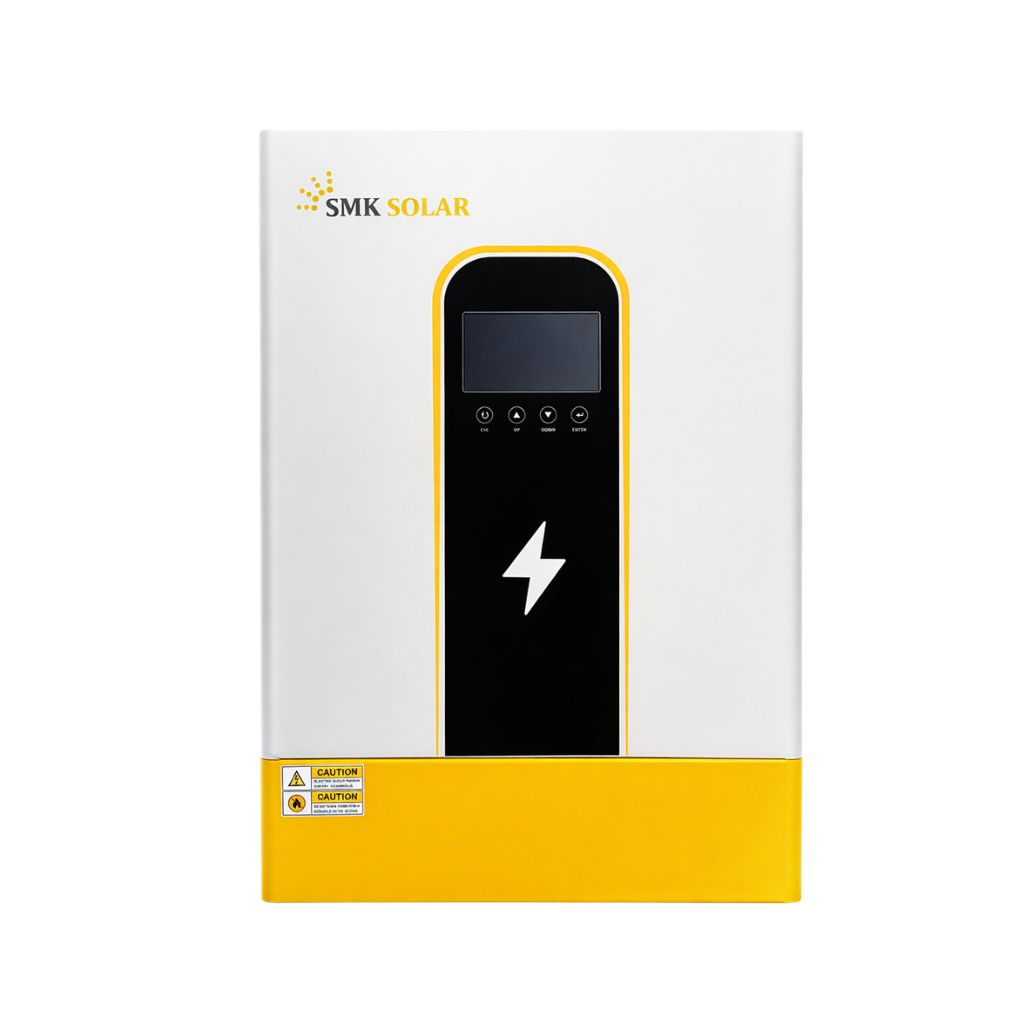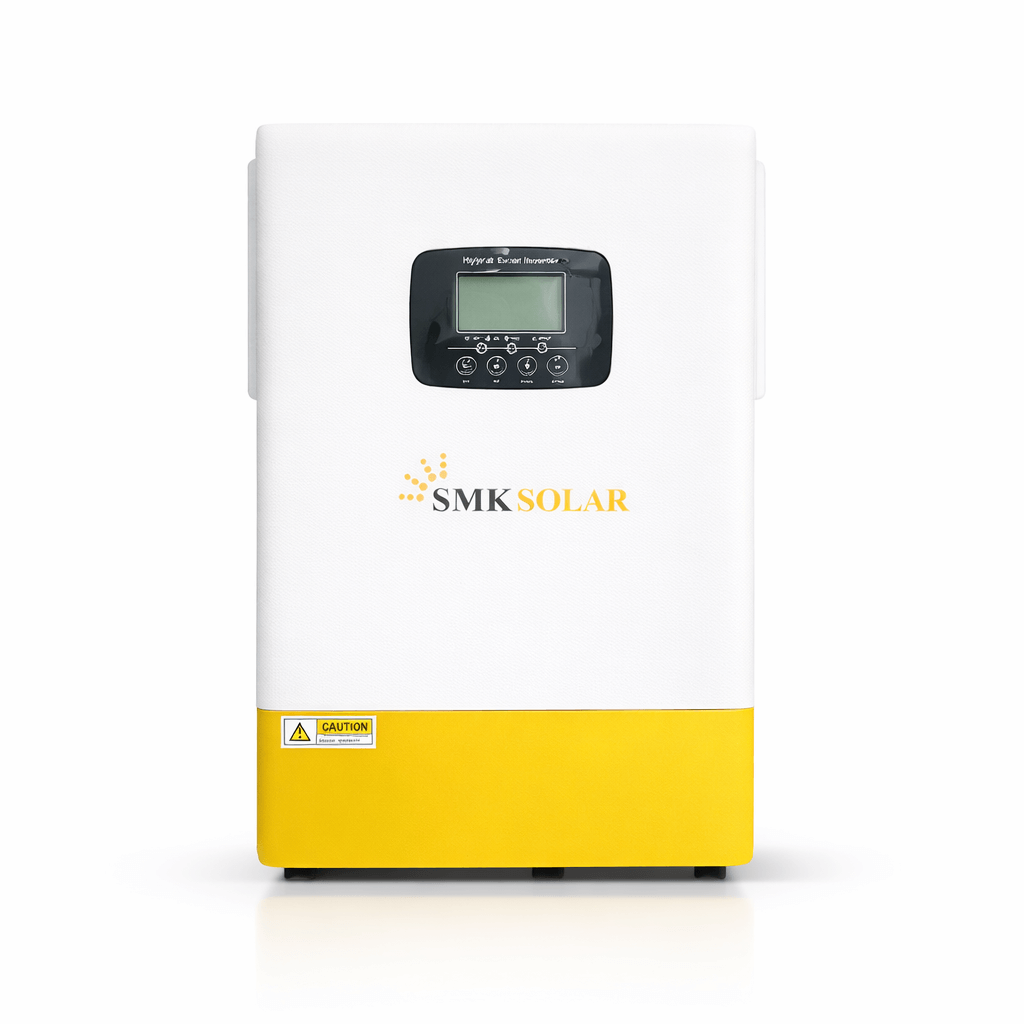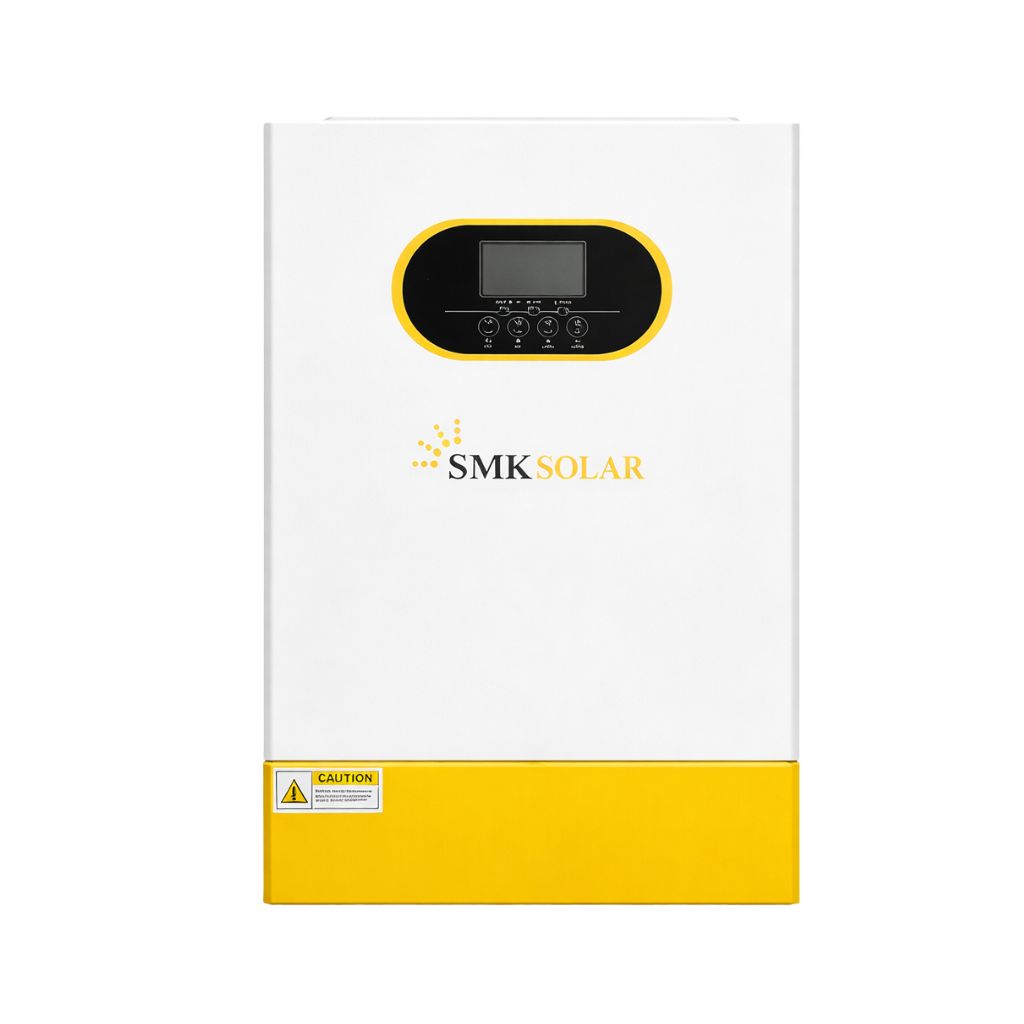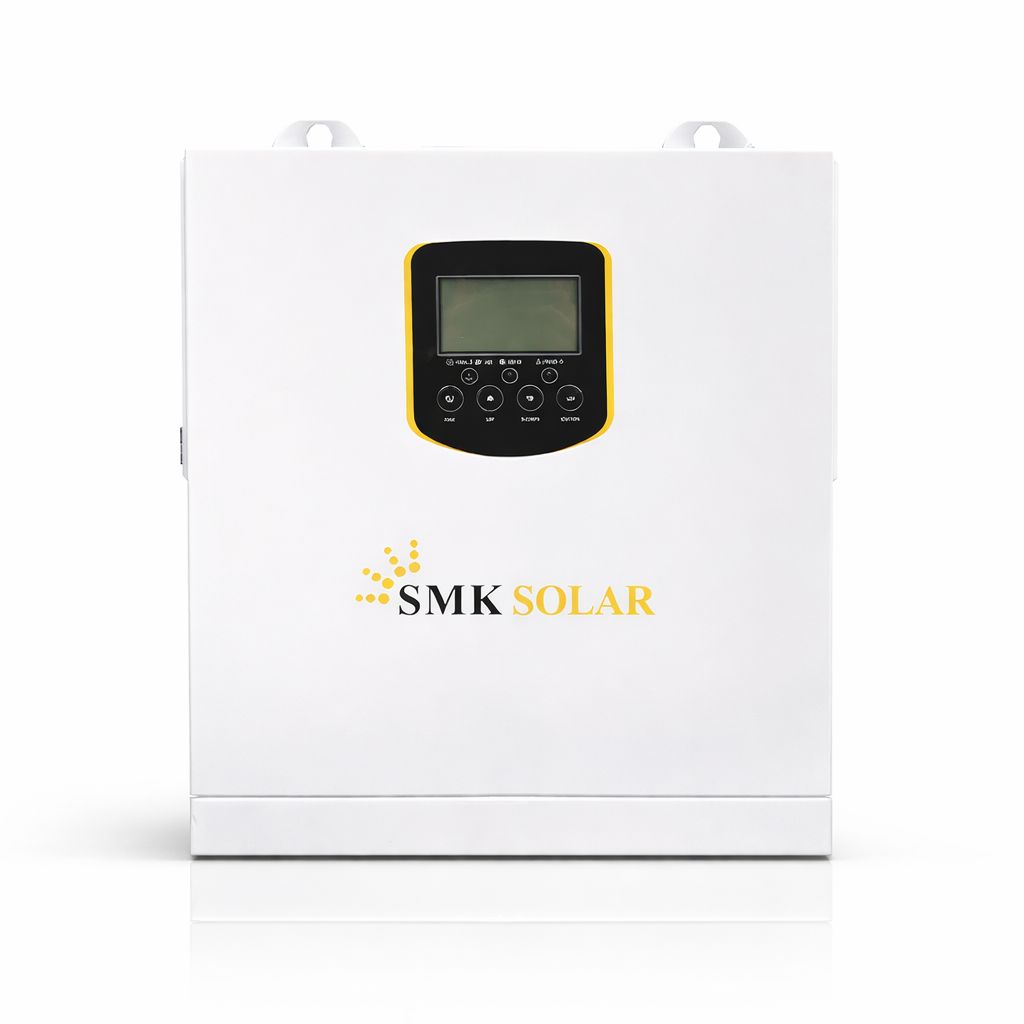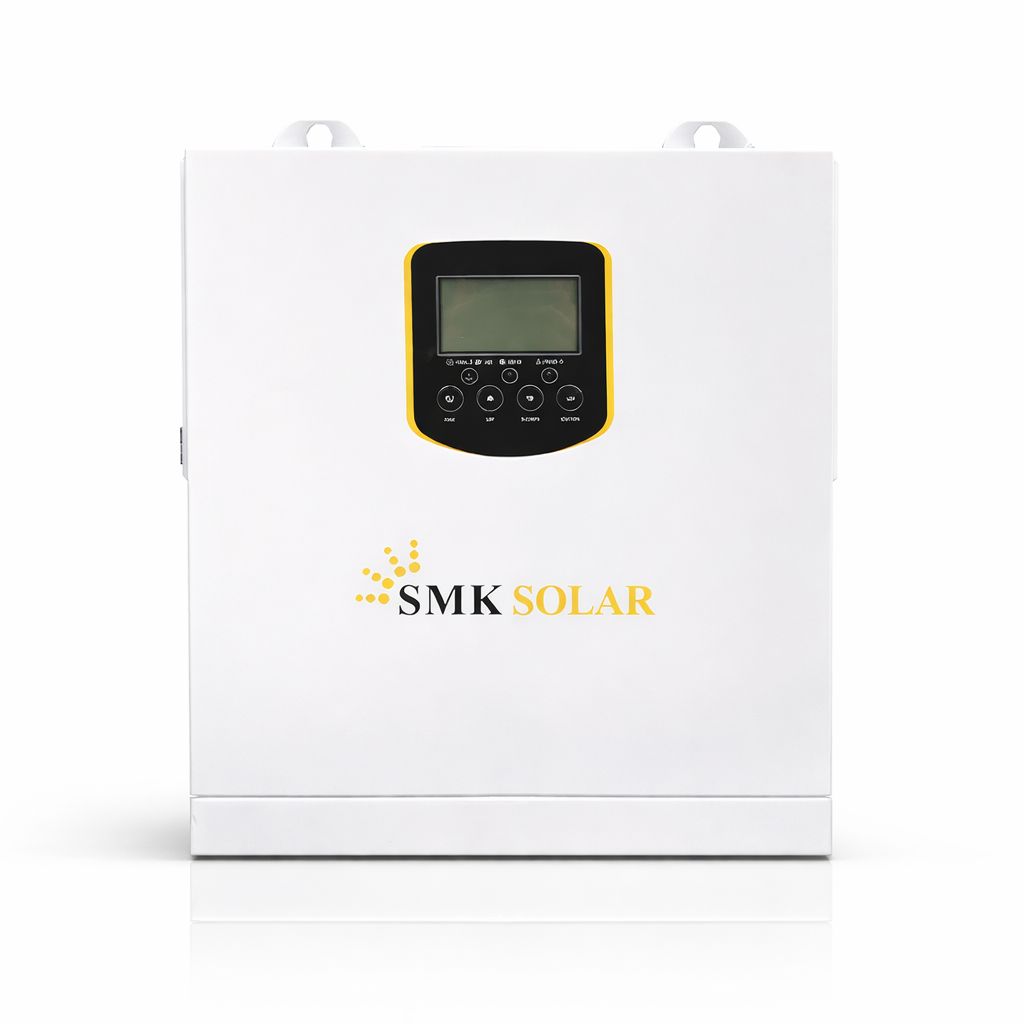
For commercial properties in Lagos or anywhere in Nigeria where a single outage shuts down everything at once — critical medical equipment, server rooms, and refrigeration losing power at the same moment as lights and fans — the problem is not just capacity, it is control. The M11000-48PL Pro is an 11kVA 48V hybrid inverter with twin AC outputs that lets you separate your most critical loads from everything else, keeping essential equipment protected on a dedicated circuit while managing the full building load across both outputs simultaneously — and it scales to six units in parallel, delivering up to 66kVA of solar-backed supply for facilities that need it. SMK Solar has been designing and delivering complete solar systems for Nigerian homes and businesses since 2016, and the M11000-48PL Pro is our most advanced single-platform commercial inverter for buyers who need both high capacity and intelligent load management in one unit.
The M11000-48PL Pro is a 48V hybrid inverter rated at 11kVA — and because it operates at a power factor of 1.0 for standard commercial and residential loads, its 11kVA rating equals 11,000 watts of real, continuous usable power. The kVA figure describes the maximum total electrical load the inverter can manage at any moment; the watts figure is what your appliances and equipment actually draw from it. For this unit running typical commercial loads, those two numbers are identical.
The feature that distinguishes this unit from every other inverter in our range is its twin AC output — two physically separate AC output terminals with independent capacity ratings. The main output handles up to 11,000W and connects to your primary load circuit: air conditioners, refrigerators, office equipment, and general building loads. The secondary output handles up to 5,500W and connects to a second circuit designated for specific loads you choose — such as medical equipment, server rooms, critical refrigeration, or security systems. This separation means that if one circuit is overloaded or needs maintenance, the other continues operating independently.
What “Hybrid” means:
A hybrid inverter actively manages three power sources simultaneously — solar panels, a battery bank, and the national grid — automatically selecting the most available and cost-efficient source at every moment based on the priority setting chosen during installation. During daylight hours, solar powers both output circuits and charges the battery at the same time. After sunset, the battery carries both circuits. If the battery runs low and NEPA supply is present, the inverter draws from the grid to sustain both circuits and recharge the battery. The M11000-48PL Pro also operates without a battery installed — running both output circuits directly from solar panel output during daylight — and can activate a lithium battery from either solar or mains supply at commissioning.
At 11,000W of continuous total output across both circuits and a 22,000VA surge capacity:
Main output circuit (up to 11,000W):
Secondary output circuit (up to 5,500W — designated for critical loads):
Parallel scaling — combined capacity across multiple units:
The M11000-48PL Pro supports parallel connection of up to six units only — not twelve like the M6200-48PL — giving a maximum combined capacity of 66kVA. If your facility requires more than 66kVA from this platform, a different parallel architecture is needed. The secondary output is rated at 5,500W, not 11,000W — loads connected to the secondary circuit must stay within that ceiling or the circuit will trip, even though the main output has remaining headroom. Both output circuits share the same battery bank and solar input, so battery sizing must account for the combined total load across both circuits, not each circuit independently. This inverter requires a 48V battery system, meaning existing 12V or 24V battery banks cannot be reused. Electric cookers, industrial water heaters, and heavy three-phase motors fall outside the practical range of this system. Our team conducts full load assessments for every commercial M11000-48PL Pro installation before specifying battery size, solar array, and parallel configuration.
The M11000-48PL Pro operates on a 48V battery system, requiring four 12V batteries in series, two 24V batteries in series, or a purpose-built 48V lithium pack. It supports LiFePO4 lithium batteries with full RS485 communication — the inverter communicates directly with the battery’s BMS (battery management system, the internal safety circuit that governs charging and discharging) to optimise charging precision and protect against overcharge or excessive drain. Lithium battery activation from either solar or mains supply means a new or deeply discharged lithium pack can be brought online without a separate activation charger. The EQ charging function extends lead-acid tubular battery life by periodically balancing individual cell charge levels across the bank — valuable at 11kVA scale where high daily cycling rates accelerate cell imbalances faster than in smaller systems. For parallel installations, battery bank sizing must cover the combined load across all connected units and both output circuits — our Lagos team calculates this precisely for every commercial installation we support.
The M11000-48PL Pro is the only inverter in our range that gives a commercial property two independent AC output circuits from a single unit — protecting your most critical equipment on a dedicated 5,500W circuit while running the full building load across both outputs simultaneously, with the option to scale the entire platform to six units without replacing a single component.
A commercial property running a 10kVA diesel generator for 10 hours daily at ₦1,500 per litre, consuming approximately 3.5 litres per hour, spends roughly ₦1,916,250 per year on fuel alone — before engine oil, filters, spark plugs, and the repair bills that come with a generator working under heavy commercial load every day. Replacing that daily runtime with solar-charged battery power through the M11000-48PL Pro, drawing from up to 11,000W of solar panels across two independent MPPT strings, eliminates the majority of that annual cost and typically delivers full system payback within 18–24 months for high-consumption commercial properties in Lagos and Abuja.
The M11000-48PL Pro delivers 96% peak solar-to-inverter efficiency and pure sine wave output across both the main and secondary AC circuits — meaning for every 100W your solar panels generate, 96W reaches your appliances rather than being lost as heat. Pure sine wave output on both circuits protects inverter air conditioners, server hardware, medical equipment, and sensitive electronics from the waveform distortion that modified sine wave inverters produce — distortion that causes inverter ACs to run above their rated current, shortens compressor life, and can permanently damage variable-speed drives and server power supplies.
A single M11000-48PL Pro replaces a solar charge controller, transfer switch, battery charger, and dual-circuit distribution panel — consolidating all of that into one 15.5kg wall-mounted unit that a qualified installer can commission in a single session. For facilities that need more, adding up to five additional units in parallel scales total capacity to 66kVA without replacing any existing hardware, reconfiguring the battery bank architecture, or retraining the facility management team on a different system.
Our team will assess your load, design the right twin-output configuration, and give you a complete M11000-48PL Pro system specification and cost.
Medical clinic and hospital facility managers in Lagos and anywhere in Nigeria who need critical equipment — vaccine refrigerators, diagnostic machines, and life support systems — on a dedicated protected circuit separate from general building loads like lighting and AC, which the secondary output provides independently.
Hotel and guesthouse operators in Lagos, Abuja and Nigeria who want to keep guest room AC and refrigeration on the main circuit while keeping front desk systems, CCTV, and communication equipment on the protected secondary circuit — ensuring security and check-in operations never go dark even if the main circuit is under heavy load.
Office complex managers in Abuja and Lagos Island running server rooms, CCTV infrastructure, and workstations on a protected secondary circuit, with general office AC, lighting, and common area loads on the main circuit — protecting IT infrastructure from any load fluctuation on the main output.
Commercial property developers in Lagos, Ibadan, Abuja building out multi-use facilities — retail on the ground floor, offices above — who need two independently managed load circuits from a single inverter platform, with the option to scale to six units as the property fills up and load increases.
Residents of large estates and luxury homes in Lagos, Abuja, or Kano with home automation systems, home theatre equipment, and medical devices that must remain protected on a separate circuit from the main household load of ACs, refrigerators, and general lighting.
Businesses anywhere in Nigeria where daily grid supply falls below 4 hours and a large commercial generator is the only current alternative — a properly sized M11000-48PL Pro system with a 48V lithium battery bank and 9,000–11,000W of solar input can cover the full facility load through a 20-hour outage on any day with adequate sunlight.
Facility managers planning future expansion who need a commercial inverter platform that starts at 11kVA and scales to 66kVA by adding identical units, without replacing any existing hardware or interrupting the system during expansion.
Spec | Value |
Model | M11000-48PL Pro |
Capacity | 11,000 VA / 11,000 W |
Twin AC Output | Yes |
Main Output Capacity | 11,000 W |
Secondary Output Capacity | 5,500 W |
Parallel Capability | Yes, up to 6 units |
Max Combined Capacity (6 units) | 66,000 VA / 66,000 W |
Nominal Input Voltage | 230 VAC |
Acceptable Input Range | 170–280 VAC (PC); 90–280 VAC (Appliances) |
Battery Voltage | 48 VDC |
Max Discharge Current | 220 A |
Solar Charger Type | Dual MPPT |
Max PV Array Power | 11,000 W (5,500 W × 2 trackers) |
Max PV Open Circuit Voltage | 500 VDC |
MPPT Voltage Range | 60 VDC – 500 VDC |
Max Solar Charge Current | 160 A |
Max AC Charge Current | 120 A |
Output Waveform | Pure Sine Wave |
Power Factor | 1.0 |
Surge Capacity | 22,000 VA |
Transfer Time | 10 ms (PC); 20 ms (Appliances) |
Peak Efficiency (PV to Inverter) | 96% |
Peak Efficiency (Battery to Inverter) | 93% |
Lithium Battery Activation | Yes (by PV or Utility) |
Lithium Battery Communication | Yes (RS485) |
Batteryless Operation | Yes |
EQ Charging Function | Yes |
Output Priority Modes | SUB / SBU / SUF |
Communication Interface | RS232 / RS485 / Dry-contact |
Ingress Protection | IP21 |
Environmental Protection | Detachable dust cover |
Dimensions (D × W × H) | 540 × 415 × 122 mm |
Net Weight | 15.5 kg |
Operating Temperature | -10°C to 55°C |
Warranty | 18 Months |
The M11000-48PL Pro provides 11,000W of total continuous output split across two independent circuits. The main output handles up to 11,000W and connects to your general building loads — air conditioners, refrigerators, lighting, fans, and computers. The secondary output handles up to 5,500W and connects to a designated critical load circuit — server rooms, medical equipment, CCTV, or any equipment you cannot afford to interrupt. Both circuits draw from the same solar, battery, and grid sources simultaneously, but their capacities are managed independently, meaning an overload on one circuit does not affect the other. In practice, a Lagos office using the main output for four ACs and general office loads while running its server room and security system on the secondary output gets continuous protection for both zones from a single inverter.
These three modes determine which power source the inverter prioritises at any moment. SBU (Solar → Battery → Utility) exhausts solar and battery before drawing from the PHCN grid — the most cost-efficient setting for Nigerian commercial properties facing high Band A tariffs, as it keeps the electricity meter inactive for the majority of any day with adequate sunlight. SUB (Solar → Utility → Battery) uses the grid as a buffer before depleting the battery, which suits facilities that want to preserve battery charge for a longer overnight period when grid supply is unpredictable. SUF (Solar → Utility → Float) runs loads from solar and grid while keeping the battery at float charge rather than cycling it deeply — useful for facilities where battery longevity is prioritised over maximum grid independence. Our team in Lagos recommends the right mode for each installation based on the client’s grid reliability, outage patterns, and electricity tariff band.
Parallel operation connects multiple M11000-48PL Pro units so they share the load and battery bank as a single, coordinated system — each additional unit adding 11,000W of capacity to both the main and secondary output circuits. Two units deliver 22kVA, four units deliver 44kVA, and the maximum of six units delivers 66kVA. This model supports up to six units in parallel — fewer than the M6200-48PL’s twelve-unit maximum, but each unit contributes 11kVA rather than 6.2kVA, making six M11000-48PL Pro units more appropriate for facilities that need high per-unit capacity with twin output on every unit rather than maximum unit count.
Yes. The M11000-48PL Pro operates in batteryless mode, running both output circuits directly from solar panel output during daylight hours with no battery bank present. This allows commercial buyers to commission the system with panels and inverter only, then add a 48V battery bank in a second phase when budget allows. At night or during cloud cover without a battery, both circuits draw from grid supply if NEPA is available, or suspend output if neither source is present.
The M11000-48PL Pro requires a 48V battery system and supports both LiFePO4 lithium and lead-acid tubular batteries, with full RS485 lithium communication for smart battery management. For a commercial installation running 8,000–9,000W across both circuits through a 12-hour overnight outage, the battery bank needs to store a significant amount of energy — the exact capacity depends on your specific load profile, acceptable depth of discharge, and whether you are using lithium or tubular batteries. Lithium batteries are strongly recommended at this scale: they tolerate deeper discharge, charge faster from the 160A solar charge current, and last significantly longer than tubular alternatives under the high daily cycling rates of a commercial installation. Our team calculates the correct bank size for every parallel M11000-48PL Pro installation we support in Lagos, Abuja, and Benin City.
The M11000-48PL Pro carries an 18-month manufacturer’s warranty covering defects in materials and workmanship under normal operating conditions. The warranty does not cover damage from incorrect installation, overvoltage from an improperly sized solar array, physical damage, water ingress beyond IP21 rating, or use with batteries outside the specified 48V range. For parallel installations, each individual unit carries its own warranty — SMK Solar supports claims for all customers who purchased through our Lagos store or authorised channels, and our installation team documents every commercial installation at commissioning to support future warranty claims.
A standard commercial inverter has one AC output, no solar charging capability, and no source management intelligence — it converts battery power to AC electricity and charges from the grid when available. The M11000-48PL Pro adds dual MPPT solar charging from 11,000W of panels, full lithium battery communication and activation, batteryless operation, twin AC output for independent load zoning, parallel scalability to 66kVA, and EQ battery management — making it an active commercial energy management platform rather than a passive backup device. The twin output alone separates it from every other inverter at this capacity level in our range.
Band A tariffs in Lagos at approximately ₦206–₦225 per kWh make every kilowatt-hour drawn from the PHCN grid a direct operating cost for commercial properties. A facility drawing 9,000W across both circuits for 10 hours daily on grid supply under Band A pays approximately ₦18,540–₦20,250 per day in electricity — over ₦6.75 million per year before accounting for the hours when grid supply is absent and a generator is running. In SBU mode, the M11000-48PL Pro exhausts solar and battery before drawing a single unit from the grid across both circuits, keeping the electricity meter inactive for the majority of any sunny day and delivering full system payback within 18–24 months for most high-consumption Lagos commercial properties.
A well-installed hybrid inverter of this class typically lasts 8–12 years under normal commercial use. At 220A of maximum discharge current — the highest rating in our entire inverter range — the DC battery wiring in this installation carries extreme current levels, and cable sizing is more critical here than for any other model we sell. Undersized cables at 220A generate dangerous sustained heat that degrades both the wiring and the inverter’s internal components, and in a commercial installation the consequences compound across parallel units if the issue is not caught at commissioning. The IP21 ingress protection rating and detachable dust cover provide environmental protection appropriate for commercial indoor installations in Lagos and Abuja — but the unit should still be installed in a ventilated, temperature-managed space away from direct outdoor exposure.
Yes — the M11000-48PL Pro is specifically appropriate for commercial and large residential facilities in communities like Benin City, Uyo, and parts of Kano where grid supply is absent for 18–22 hours daily and where load zoning between critical and non-critical circuits is as important as raw capacity. In SBU mode, any brief NEPA supply period is used to recharge the battery as a reserve rather than power loads directly, maximising stored energy for the overnight period across both output circuits. For a facility with 8,000–9,000W of combined load through a 20-hour outage, our Lagos team will calculate the exact 48V battery bank capacity needed and the solar array size required across the dual MPPT inputs to make the system genuinely self-sufficient on days with adequate sunlight.
Step into any of our branches in Lagos, Kano, Benin, or Uyo to see our SMK technology in action and speak with our technical team.
Tell us what you need to power, and our engineers will design a customized SMK Solar solution tailored to your home or business.
Have questions or need advice? Reach out to our professional team and get fast, reliable assistance.