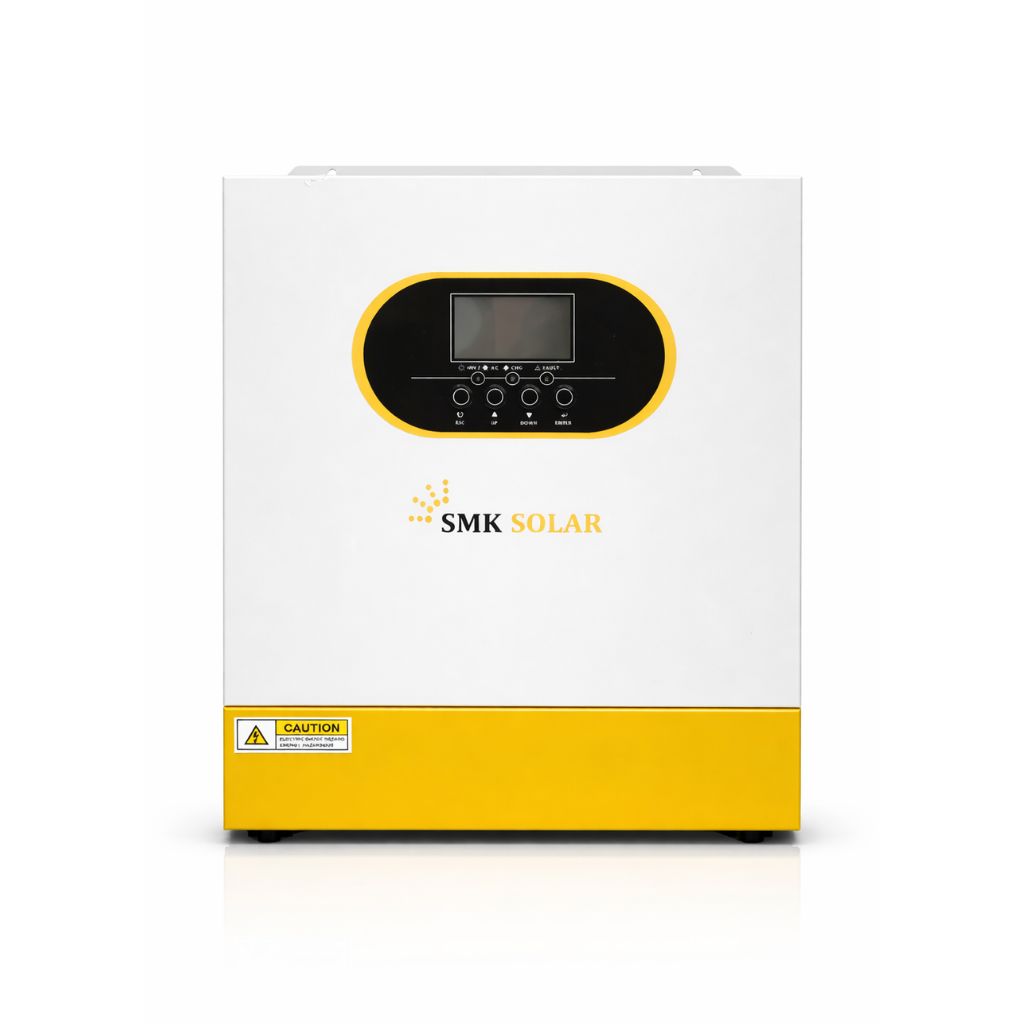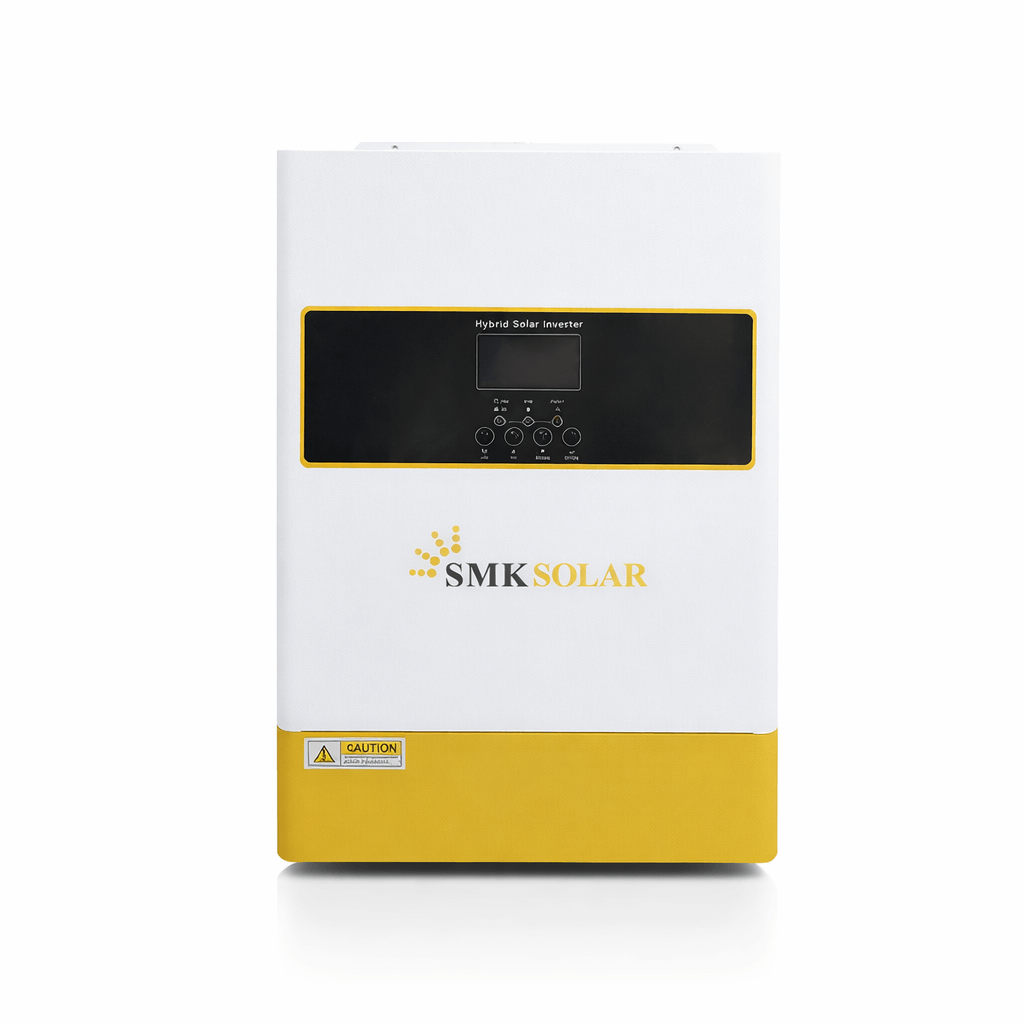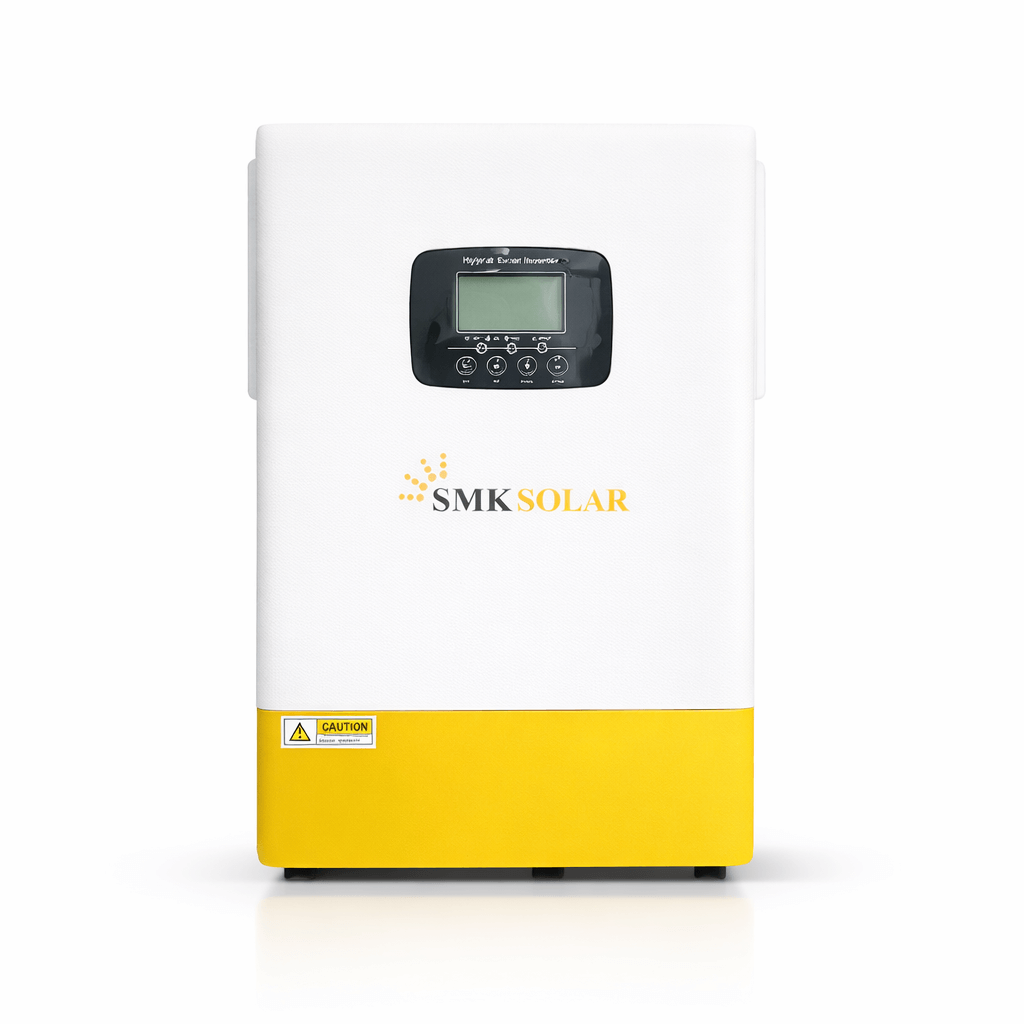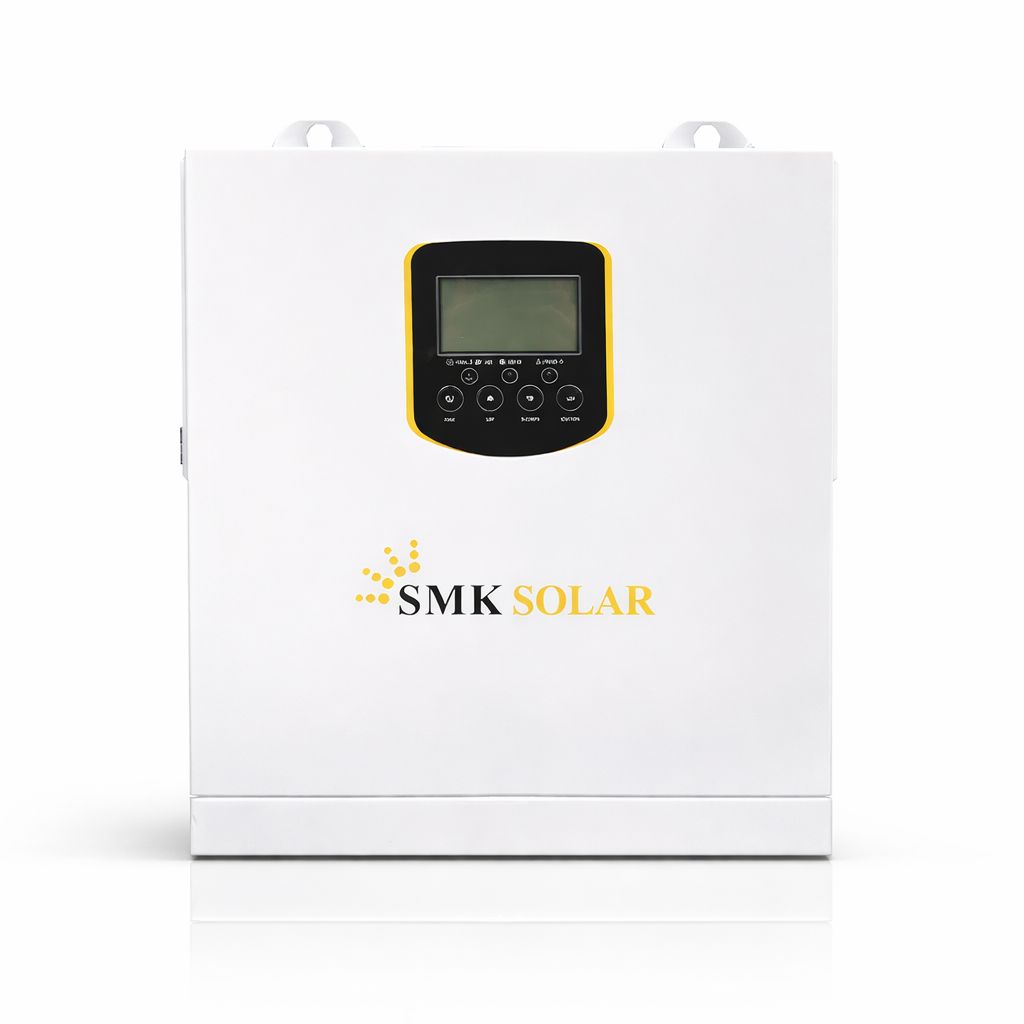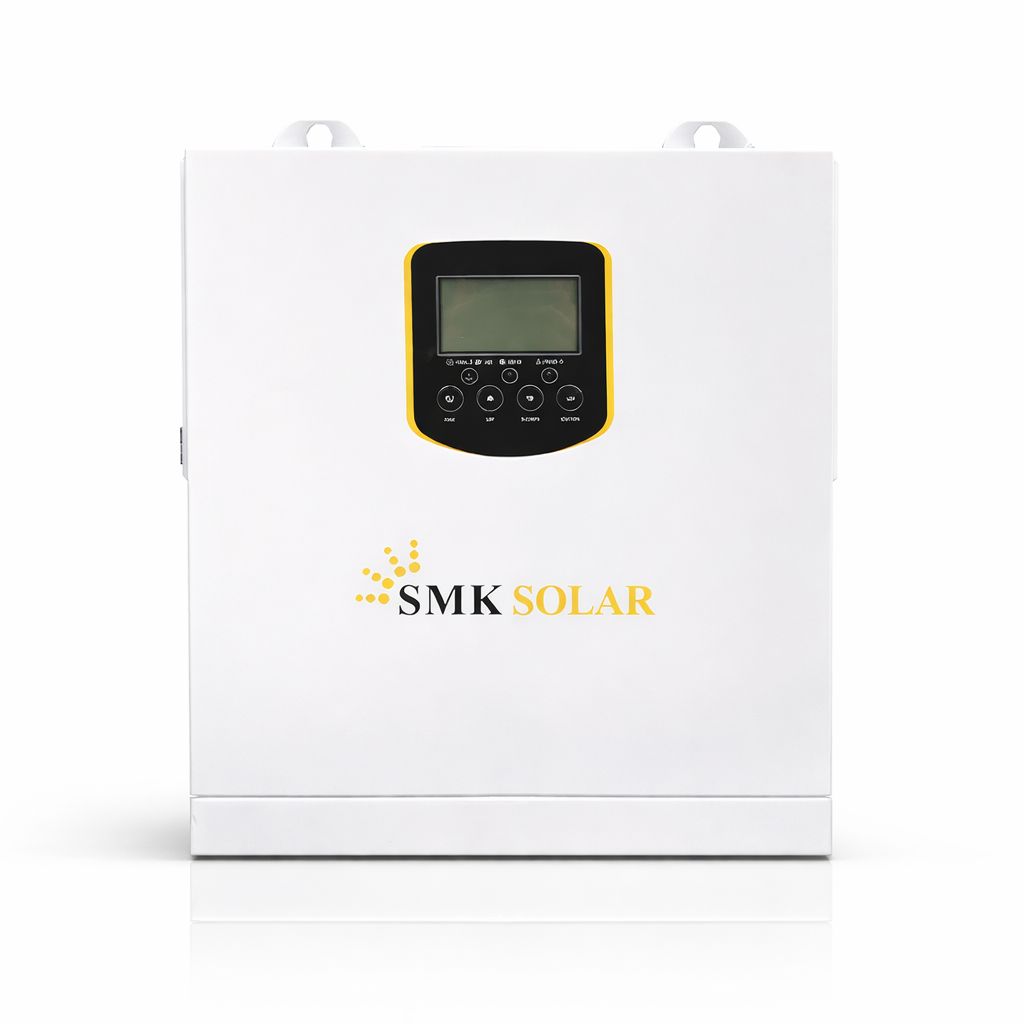
Between Band A electricity tariffs pushing Lagos household bills past ₦50,000 monthly and petrol now costing enough that running a generator through a 16-hour outage feels like a financial penalty, many Nigerian homes and small businesses are looking for a system that does more than just provide backup — they need one that actively reduces what they spend on power every single day. The EM3500-24L 3.5kVA Hybrid Inverter is built for exactly that situation: a 24V system that manages solar panels, battery, and grid automatically, supports both lithium and lead-acid batteries, and can even operate without a battery connected when solar panels alone are sufficient to power your loads. SMK Solar has been designing and delivering complete solar systems for Nigerian homes and businesses since 2016, and this inverter represents one of the most versatile options in our current range.
The EM3500-24L is a 24V hybrid inverter rated at 3.5kVA — and because it operates at a power factor of 1.0 for standard home and office loads, its 3.5kVA rating equals 3,500 watts of real, usable power. The kVA figure describes the maximum total load the inverter can manage at any moment; the watts figure is what your appliances actually consume from it. For this unit running typical household loads, those two numbers are identical.
What “Hybrid” means:
A hybrid inverter is not simply a backup device — it is an active energy manager. It monitors three power sources simultaneously: solar panels, a battery bank, and the national grid, and automatically selects which one to draw from at every moment based on your chosen priority and what is currently available. During daylight hours, solar powers your appliances and charges the battery at the same time. After sunset, the battery takes over. If the battery runs low and NEPA supply is available, the inverter draws from the grid to sustain your loads and top up the battery. All of this happens automatically, continuously, without any intervention from you.
What makes the EM3500-24L stand apart from standard hybrid inverters is its ability to operate entirely without a battery when solar panels are generating sufficient power — a feature that allows you to start with panels only and add a battery bank later as your budget allows.
With 3,500W of continuous output and a 7,000VA surge capacity designed to absorb the high startup current of compressor-driven appliances:
The EM3500-24L does not support parallel connection, meaning two units cannot be linked to expand output beyond 3.5kVA. If your load requirements may grow to 5kVA or beyond in the near future, a parallelable inverter is the smarter starting point. Electric cookers, electric water heaters, pressing irons, and borehole pumps above 0.5HP are also outside the practical range of this system — their heating elements and large motors draw continuous power that would push this inverter to or beyond its limit while leaving nothing for other appliances. A 1.5HP or larger air conditioner carries the same caution: the startup surge may be manageable, but the continuous running load combined with other household appliances could regularly push total consumption past 3,000W. Our team in Lagos is available to review your full appliance list and confirm whether this unit is the right fit before you commit.
The EM3500-24L operates on a 24V battery system and is one of the few inverters in this capacity class to offer full LiFePO4 lithium battery support through RS485 communication — meaning it can talk directly to a compatible lithium battery’s BMS (battery management system), the internal safety circuit that controls how the battery charges and discharges, to optimise charging precision and protect the battery from overcharge or excessive drain. For buyers starting with a conventional battery, two 12V tubular batteries wired in series provide a practical and widely available starting point. The EQ (equalisation) charging function periodically applies a controlled overcharge to lead-acid tubular batteries to balance cells and extend overall battery life — a feature that meaningfully extends the period before a battery bank needs replacing. When you are ready to upgrade to lithium, the inverter is already equipped to support that transition without any hardware changes. Our team can help you build and size the right battery system for your load and budget.
The EM3500-24L is designed for buyers who want a system that does not become obsolete as their needs or budget evolves — start with panels only, add a tubular battery bank, and upgrade to lithium when you are ready, all without replacing the inverter at the centre of the system.
A household in Lagos running a 2.5kVA petrol generator for 8 hours daily at ₦1,500 per litre, consuming roughly 1.5 litres per hour, spends approximately ₦540,000 per year in fuel before a single maintenance visit. Replacing the majority of that runtime with solar-charged battery power through the EM3500-24L — drawing from up to 4,000W of solar panels during daylight — reduces that annual cost significantly, with most Lagos and Abuja households recovering the system cost within 18–24 months purely from fuel savings.
The EM3500-24L produces pure sine wave electricity — the clean, smooth waveform that inverter air conditioners, modern refrigerators, laptops, and medical equipment are engineered to receive. Modified sine wave inverters, still widely sold at lower price points, deliver a stepped electrical signal that causes inverter ACs to run below their rated efficiency, shortens compressor and motor lifespan, and can cause permanent damage to variable-frequency drive components — damage that no appliance warranty in Nigeria will cover.
The EM3500-24L combines solar charge controller, automatic transfer switch, battery charger, and inverter output in a single unit — eliminating the cost, wiring complexity, and additional failure points of a multi-component setup. With four output priority modes (UTL, SOL, SBU, SUB), an optional WiFi monitoring module, and a detachable dust cover for harsh harmattan and coastal environments, it is built to operate without daily attention.
Our team will review your appliance list and tell you exactly what a complete EM3500-24L system covers and costs for your home or business.
Medium household owners in Lagos running a 1HP AC, refrigerator, and multiple rooms of lighting who need an inverter with the surge capacity to start a compressor reliably — the 7,000VA surge rating absorbs that startup load without a trip or flicker.
Home office professionals and remote workers in Abuja or Lagos Island running computers, monitors, WiFi, and climate control simultaneously, where an unplanned shutdown mid-call or mid-deadline is not an option.
Small business owners operating a pharmacy, diagnostics centre, provision store, or print business who need refrigeration, lighting, POS systems, and an AC unit all active through outages — without the noise, fumes, or daily fuel cost of a generator.
Residents in Uyo, Akwa Ibom, Benin City, and anywhere in Nigeria where daily grid availability falls below 4-6 hours — paired with a 200Ah 24V battery bank and 2,000-4,000W of solar panels, this inverter can cover essential household loads through the full outage window on any day with reasonable sunlight.
Buyers planning a phased solar installation who want to start with solar panels only — the batteryless operation mode means the inverter can power loads directly from panels during daylight without a battery installed, and a battery bank can be added later.
Homeowners already using tubular batteries who want an inverter with an EQ charging function that automatically extends their battery life, delaying the cost of replacement by balancing battery cells during periodic charge cycles.
Forward-thinking buyers who want to move to lithium batteries in the future without replacing their inverter — the EM3500-24L's RS485 lithium communication is already built in and ready to pair with a compatible LiFePO4 battery pack when the time comes.
Spec | Value |
Model | EM3500-24L |
Capacity | 3,500 VA / 3,500 W |
Battery Voltage | 24 VDC |
Floating Charge Voltage | 27 VDC |
Overcharge Protection | 33 VDC |
PV Input Voltage Range | 60 VDC – 500 VDC |
Max PV Array Power | 4,000 W |
Built-in MPPT Rating | 60A / 100A / 120A |
Max Solar Charge Current | 100 A |
Max AC Charge Current | 80 A |
Max Total Charge Current (PV + AC) | 100 A |
Output Waveform | Pure Sine Wave |
Power Factor | 1.0 |
Surge Capacity | 7,000 VA |
Lithium Battery Activation | Yes (by PV only) |
Lithium Battery Communication | Yes (RS485) |
Batteryless Operation | Yes |
EQ Charging Function | Yes |
Output Priority Modes | UTL / SOL / SBU / SUB |
Remote Monitoring | Optional WiFi |
Environmental Protection | Detachable dust cover |
Dimensions (D × W × H) | 358 × 295 × 100 mm |
Net Weight | 7.00 kg |
Warranty | 18 Months |
The EM3500-24L provides 3,500W of continuous output, which comfortably covers a 1HP split-unit air conditioner, an energy-efficient refrigerator, up to 10 LED bulbs, two or three fans, a large television, a laptop or desktop, and a WiFi router all running simultaneously. A combined running load of those appliances typically sits between 1,800W and 2,300W — well within the inverter’s continuous ceiling and leaving genuine headroom for additional devices. Electric kettles, pressing irons, electric cookers, and borehole pumps are not suitable — their continuous draw would consume most or all of the inverter’s capacity while leaving nothing for other appliances.
Yes — and this is one of the features that sets the EM3500-24L apart from most inverters in this class. It can operate in batteryless mode, drawing power directly from solar panels to run connected appliances during daylight hours without any battery bank installed. This means you can begin using the inverter with panels only and add a battery bank at a later stage when your budget allows, without replacing or reconfiguring the inverter itself. At night or during cloudy periods without a battery, the inverter will switch to grid power if available.
Yes. The EM3500-24L functions as a full battery backup inverter using only a battery bank and grid supply, with no solar panels required at the point of installation. When NEPA supply is present, it charges the battery from the grid; when the grid goes down, it switches to battery power automatically. Solar panels can be added at any point — the built-in MPPT controller supports up to 4,000W of solar input and will begin harvesting energy as soon as panels are connected.
The EM3500-24L is compatible with both LiFePO4 lithium batteries and conventional lead-acid tubular batteries on a 24V system. For lithium, the inverter communicates directly with the battery’s BMS — battery management system, the internal circuit that governs safe charging and discharging — via RS485, which allows it to charge the lithium battery with precision and protect it from overcharge or excessive drain. Lithium batteries last significantly longer than tubular options and tolerate deeper discharge without degrading, making them the stronger long-term investment for high daily usage. For buyers starting with tubular batteries, the inverter’s built-in EQ function periodically balances the battery cells to extend their usable life.
EQ stands for Equalisation — a charging mode where the inverter periodically applies a carefully controlled higher charge voltage to a lead-acid tubular battery to balance the charge level across all cells. Over time, individual cells in a battery bank charge and discharge at slightly different rates, causing some to become weaker than others and reducing overall capacity. The EQ function corrects this imbalance before it becomes permanent, extending the battery bank’s usable life and maintaining its full storage capacity for longer. For Nigerian buyers running tubular batteries through daily deep discharge cycles, this function can meaningfully delay the cost of battery replacement.
The EM3500-24L supports UTL (Utility First), SOL (Solar First), SBU (Solar → Battery → Utility), and SUB (Solar → Utility → Battery). UTL runs loads from the grid whenever NEPA is present and reserves solar and battery as backup — this minimises battery cycling but does nothing to reduce your electricity bill. SOL prioritises solar during daylight hours, supplementing from battery or grid as needed. SBU is the most cost-efficient mode for most Nigerian conditions — it exhausts solar and battery before drawing any grid power, keeping your PHCN meter as inactive as possible. SUB is similar to SBU but uses the grid as a buffer before the battery, which suits situations where you want to preserve battery charge for a longer night period.
A standard inverter converts battery power to AC electricity and recharges the battery from the grid — that is its complete function. It cannot accept solar panels, cannot manage multiple power sources, and cannot reduce your electricity bill or generator dependency in any active way. The EM3500-24L adds a 4,000W solar charging capability, full lithium battery communication, batteryless operation, four priority modes, and an EQ battery maintenance function — making it an active energy management system rather than a passive backup device. The practical difference shows up every month in your fuel and electricity spending.
The EM3500-24L carries an 18-month manufacturer’s warranty covering defects in materials and workmanship under normal operating conditions. The warranty does not cover damage from incorrect installation, overvoltage from a poorly sized solar array, physical damage, flooding, or connection of incompatible batteries outside the inverter’s specified voltage range. SMK Solar supports warranty claims for customers who purchased through our store or authorised channels — retain your purchase receipt and note your installation date, as both are required when raising a claim.
A well-installed hybrid inverter of this class typically lasts 8–12 years under normal residential or light commercial use. The most common causes of early failure in Nigerian installations are poor ventilation causing heat buildup, undersized battery cables generating excessive resistance, and battery mismatch forcing the charger to work harder than its design tolerates. The EM3500-24L’s detachable dust cover directly addresses one of the most overlooked failure causes in Kano, Abuja, and inland Lagos installations — dust accumulation in cooling vents — and its operating range extends to handle Nigeria’s climate conditions comfortably when installed in a shaded, ventilated location.
Yes — the EM3500-24L is specifically well-suited for communities in Nigeria where daily grid availability can fall to 2–4 hours or less. In SBU mode, the inverter exhausts solar and battery before drawing from the grid, meaning even brief NEPA availability is used to top up the battery rather than power loads directly — preserving every available grid unit as a reserve. Paired with a 200Ah 24V tubular or lithium battery bank and 2,000–4,000W of solar panels, this system can realistically cover essential household loads through a 20-hour outage on a day with good Lagos or Abuja sunlight, with the battery entering the night period at or near full capacity.
Step into any of our branches in Lagos, Kano, Benin, or Uyo to see our SMK technology in action and speak with our technical team.
Tell us what you need to power, and our engineers will design a customized SMK Solar solution tailored to your home or business.
Have questions or need advice? Reach out to our professional team and get fast, reliable assistance.
WhatsApp us