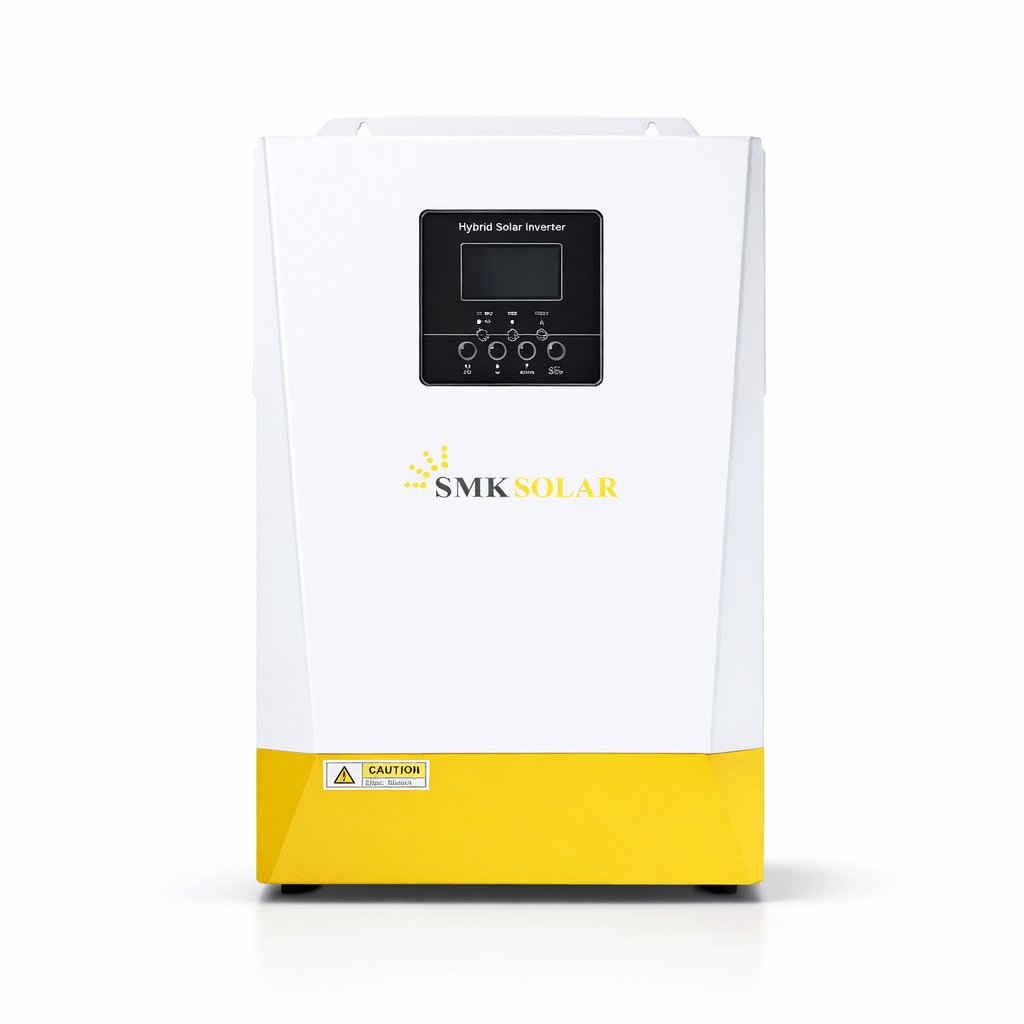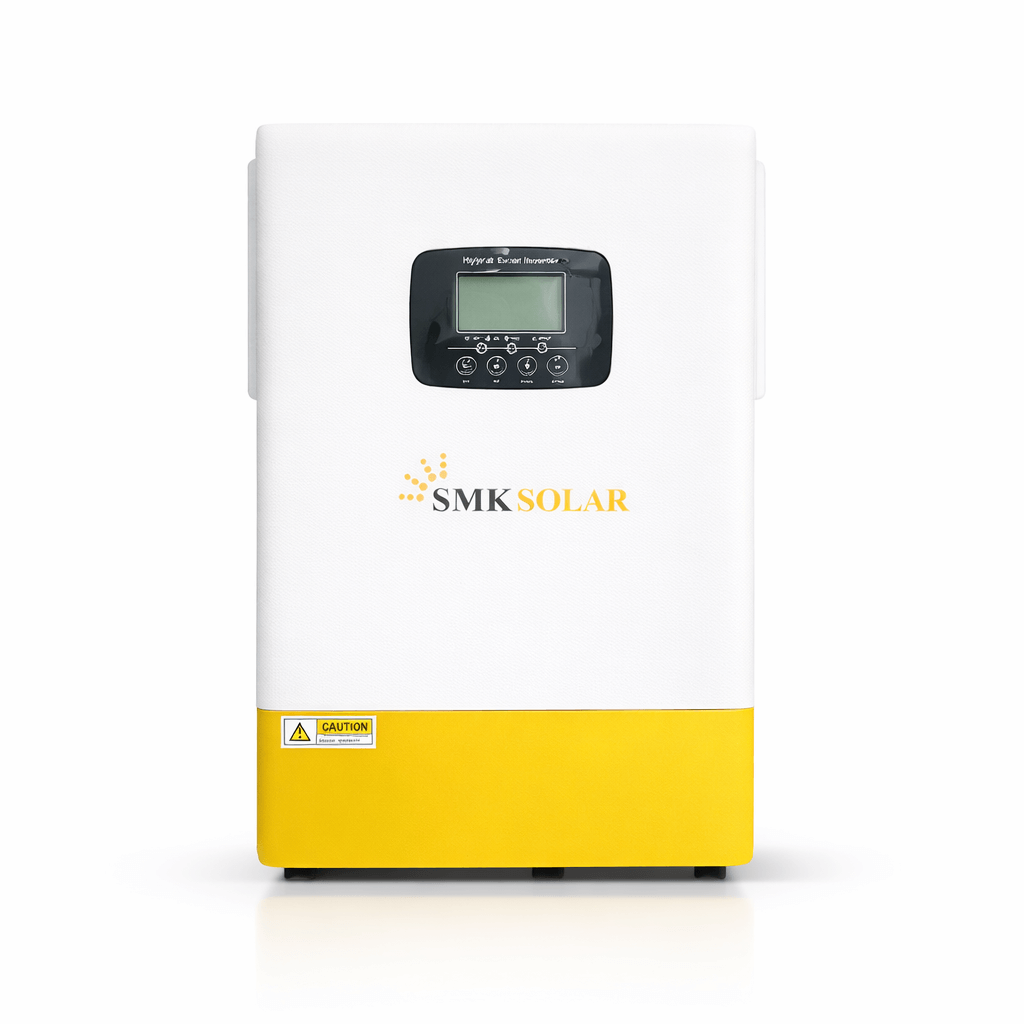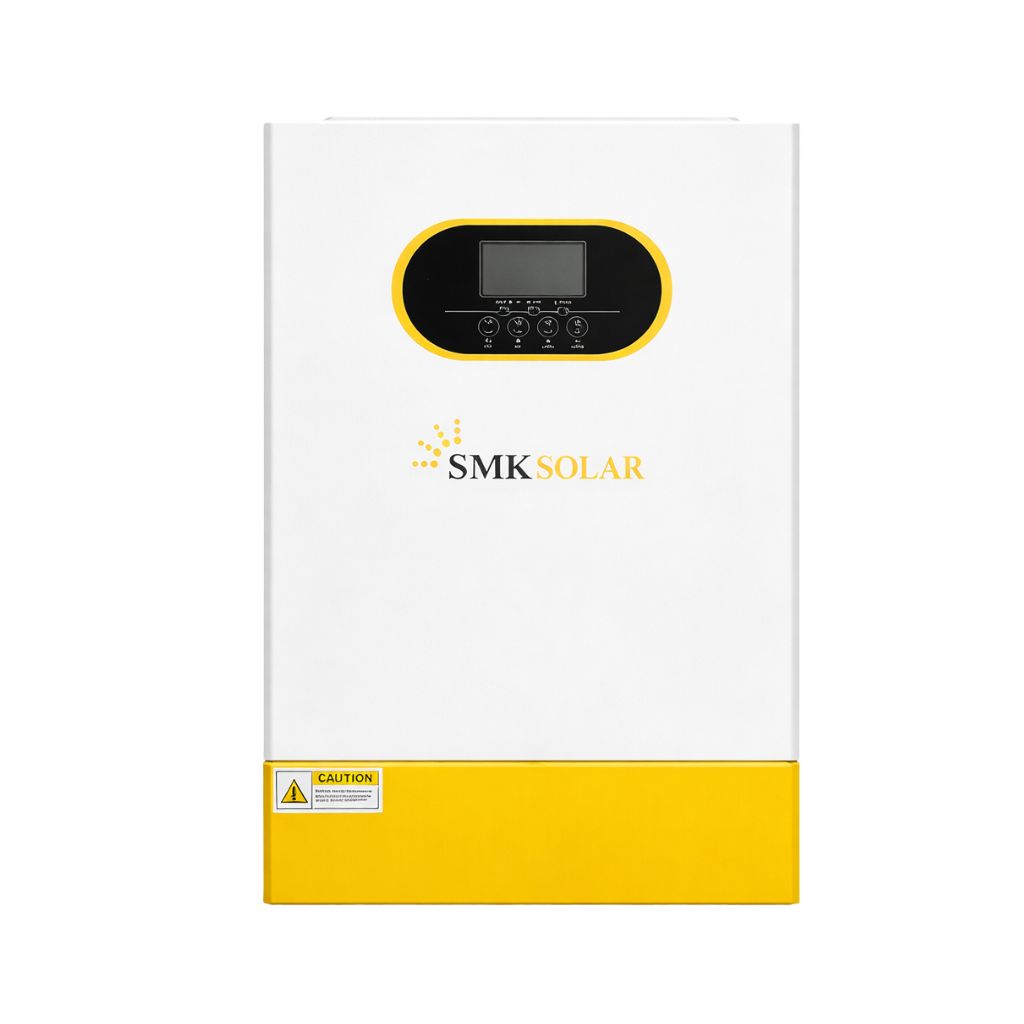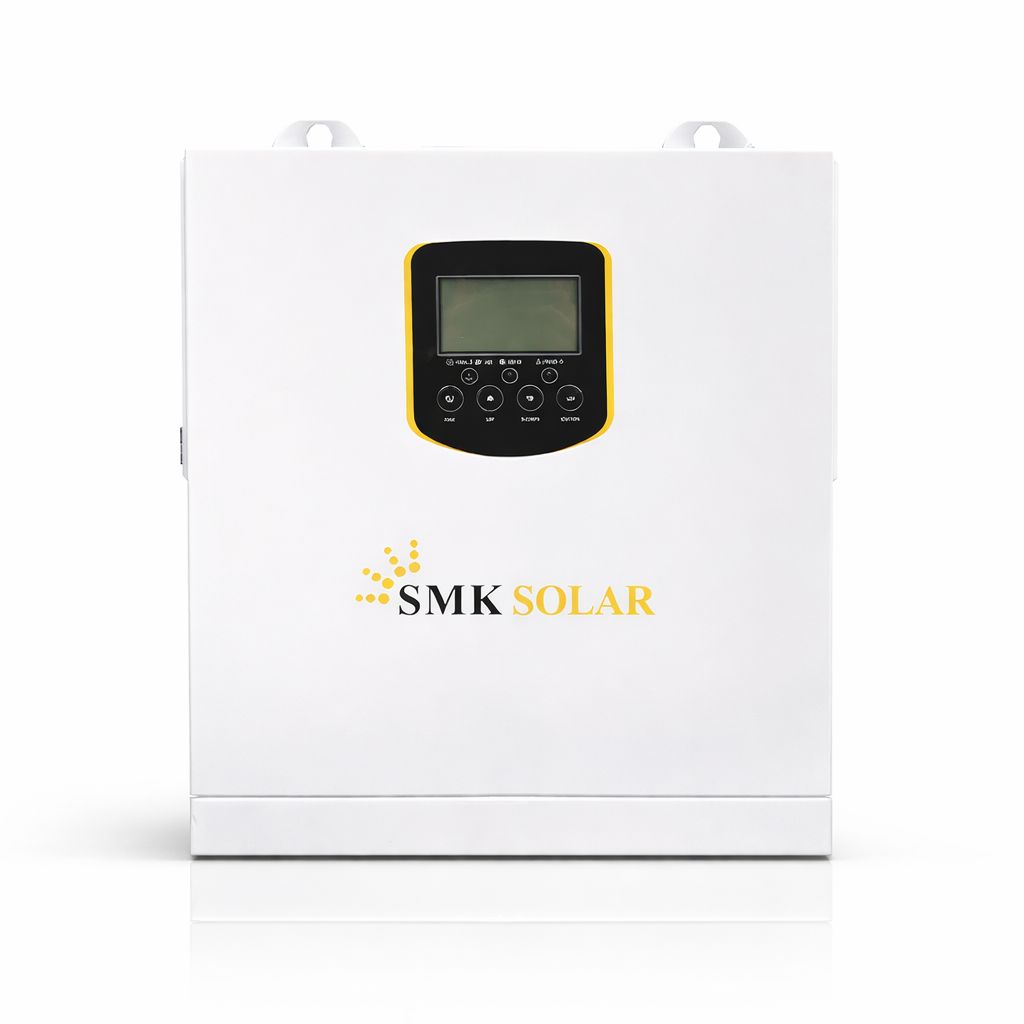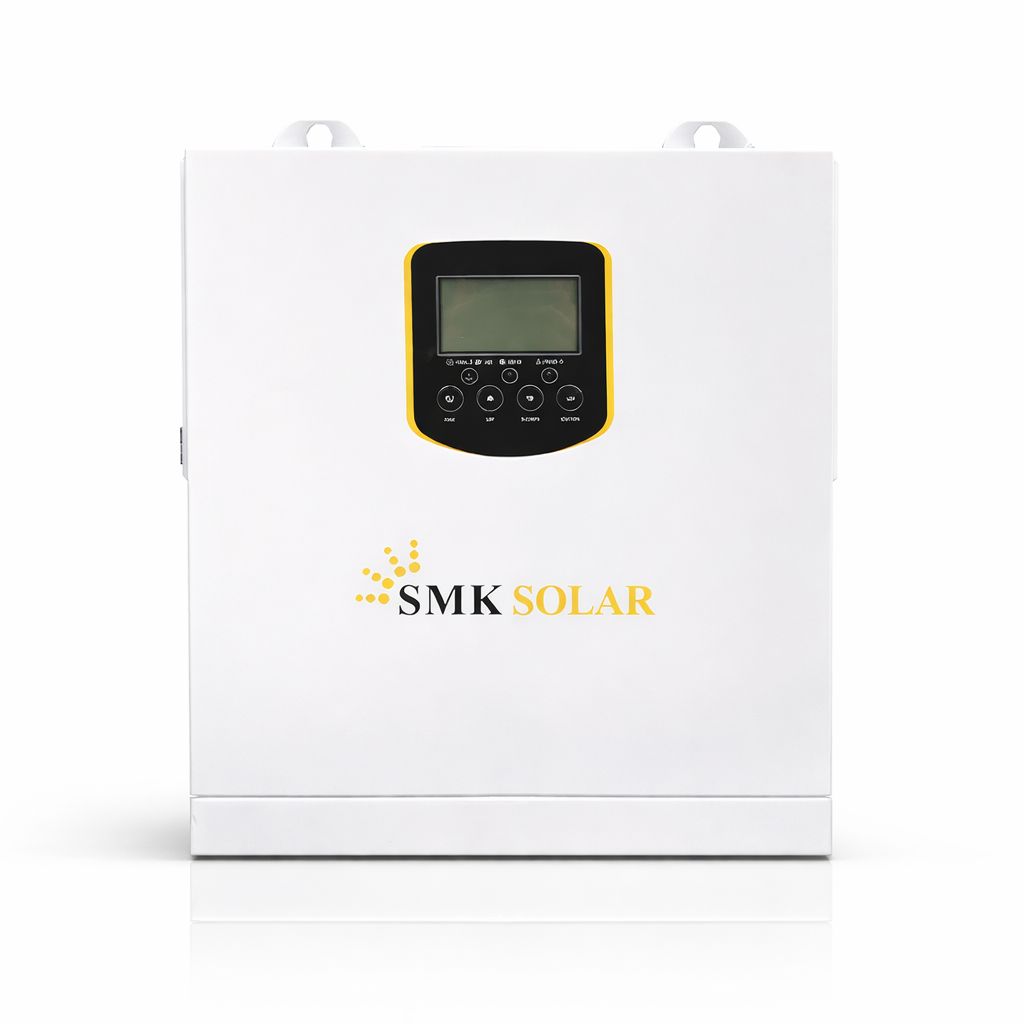
Whether you are running a large Lagos home or managing a commercial facility whose generator bill has climbed past ₦1.5 million a year, the M5500 series gives you a single inverter platform that grows with your energy needs. The M5500-48 handles a full residential load on its own, while the M5500-48PL can be connected with up to 11 additional units to deliver up to 66kVA of solar-backed power in single-phase or three-phase configuration — making it one of the most scalable hybrid inverter options available in Nigeria today. SMK Solar has been designing and installing complete solar systems for Nigerian homes and businesses since 2016, and the M5500 series is our recommendation for any buyer whose power needs may outgrow a single inverter within the next few years.
The M5500 series are 48V hybrid inverters, each rated at 5.5kVA — and because both models operate at a power factor of 1.0 for standard home and office loads, their 5.5kVA rating equals 5,500 watts of real, continuous usable power per unit. The kVA figure describes the maximum total electrical load the inverter can manage at any moment; the watts figure is what your appliances actually draw from it. For these units running typical Nigerian household or commercial loads, those two numbers are identical. Think of each unit like a lane on a highway — a single M5500-48 gives you five and a half thousand watts of throughput, and the M5500-48PL lets you add up to eleven more lanes alongside it, scaling total system capacity all the way to 66,000W without changing the core inverter technology.
The two models share an identical power architecture, efficiency rating, solar input capacity, and physical form factor. The single difference is that the M5500-48PL supports parallel connection of up to 12 units in single-phase or three-phase configuration, while the M5500-48 operates as a standalone unit. Both include a built-in mobile screen for direct system monitoring without a phone or additional device.
What “Hybrid” means:
A hybrid inverter manages three power sources simultaneously — solar panels, a battery, and the national grid — and automatically selects which one to draw from at every moment based on your chosen priority setting. During daylight hours, solar powers your appliances and charges the battery at the same time. After sunset, the battery carries the load. If the battery runs low and NEPA supply is present, the inverter draws from the grid to sustain your appliances and recharge the battery for the next cycle. Both M5500 models can also operate without a battery installed, running loads directly from solar panel output during daylight — which means you can commission the system with panels only and add battery storage later.
At 5,500W of continuous output per unit and 11,000VA of surge capacity:
For the M5500-48PL in a parallel configuration, multiply the available capacity by the number of units connected — two units deliver 11kVA, four units deliver 22kVA, and twelve units deliver 66kVA, making it suitable for event centres, office complexes, filling stations, clinics, and multi-unit residential developments across Lagos, Abuja, and Nigeria at large.
The M5500-48 is a standalone unit with no expansion capability — if your load grows beyond 5.5kVA, you would need to replace it rather than add to it. If there is any possibility your power needs will scale in the near future, the M5500-48PL is the smarter starting point, as it allows you to begin with one unit and add more as your load or budget grows. Neither model supports electric cookers, water heaters, pressing irons, or borehole pumps above 1HP — their heating elements and large motors draw continuous power that crowds out every other appliance on the circuit. Both units require a 48V battery system, meaning four 12V batteries in series, two 24V batteries in series, or a purpose-built 48V lithium pack — existing 12V or 24V battery banks from a previous inverter cannot be reused without significant expansion. Our team in Lagos will help you determine whether the standalone or parallel model is the right fit before you commit.
If you are powering a single home, apartment block, or small business and have no plans to expand the system beyond 5.5kVA, the M5500-48 gives you everything you need at a lower cost. If you are powering a commercial property, a large facility, a multi-unit development, or any installation that may need more capacity in the future, the M5500-48PL is the practical choice — start with one unit, add more as your load grows, and never replace the inverter at the centre of the system.
Both M5500 models operate on a 48V battery system, requiring four 12V batteries wired in series, two 24V batteries in series, or a single 48V lithium battery pack. Both are compatible with LiFePO4 lithium batteries. Lithium batteries are the stronger long-term investment at this capacity level — they last 8–10 years under regular deep cycling, charge faster, and tolerate deeper discharge without capacity loss. For buyers starting with conventional lead-acid tubular batteries, the 48V configuration still delivers strong performance and the system can be upgraded to lithium at a later stage. For M5500-48PL installations in a parallel configuration, battery bank sizing becomes a critical calculation — each additional unit increases both the load coverage and the charging demand on the battery bank. Our team can size the right battery capacity for your specific configuration and daily load.
The M5500 series is the only inverter in our range that serves both a large residential buyer and a commercial or multi-property buyer from the same platform — start with a single 5.5kVA unit and expand to 66kVA simply by adding more units, without replacing any existing hardware or rewiring the system from scratch.
A Lagos household or small business running a 4kVA petrol generator for 8 hours daily at ₦1,500 per litre, consuming roughly 2 litres per hour, spends approximately ₦720,000 per year on fuel before a single maintenance cost — and commercial properties running larger generators spend considerably more. Replacing that daily runtime with solar-charged battery power through the M5500 series, drawing from up to 5,500W of solar panels per unit, eliminates the majority of that annual cost and typically delivers full system payback within 18–24 months for high-consumption Lagos and Abuja properties.
Both M5500 models deliver pure sine wave electricity — the smooth, consistent waveform that inverter air conditioners, variable-speed refrigerator compressors, laptops, medical equipment, and office electronics are all designed to receive. Modified sine wave inverters, still widely sold in Lagos and Kano markets at lower price points, produce a stepped waveform that causes inverter ACs to draw more current than rated, accelerates compressor wear, and damages sensitive electronics over time — consequences that compound significantly in a commercial installation where multiple high-value appliances are connected simultaneously.
The built-in mobile screen on both models gives any user — technical or not — a live view of solar input, battery state, and load consumption directly on the inverter face, without a phone, app, or additional monitoring hardware. For the M5500-48PL in a parallel installation, a single monitoring interface covers the entire array of connected units, simplifying operation management for facility managers and business owners who are not solar engineers.
Our team will review your load and property type and recommend the right M5500 configuration for your specific situation.
Large household owners in Lagos running two split-unit air conditioners, a full-size refrigerator, a freezer, and whole-house lighting who need a single 5.5kVA unit that handles the full load without tripping — the M5500-48 covers this load comfortably within its continuous output ceiling.
Multi-floor duplex owners in Abuja and Lagos where a single 3.5kVA inverter cannot cover both floors simultaneously — a single M5500-48 or two M5500-48PL units in parallel brings the entire property under one managed power circuit.
Small business owners operating a pharmacy, clinic, busy office, or cold storage facility in Lagos or Benin City who need refrigeration, multiple AC units, computers, and POS systems active through daily outages without the fuel cost and noise of a large generator.
Commercial property and facility managers in Lagos, Abuja, or Kano running event centres, office complexes, filling stations, or hotels who need scalable power beyond 5.5kVA — the M5500-48PL supports up to 12 units in parallel, delivering up to 66kVA of solar-backed supply in single-phase or three-phase configuration.
Residents in Ibadan, Ogun, and anywhere in Nigeria where daily grid availability falls below 5 hours — paired with a 48V lithium battery bank and 4,000–5,500W of solar panels per unit, this inverter covers a full household load through a 20-hour outage on any day with adequate sunlight.
Property developers and multi-unit landlords in Lagos fitting out apartment blocks or short-let properties who need a scalable solar system that starts at one unit per floor and expands as the property grows, all within the same inverter platform.
Buyers currently on a smaller inverter who are regularly tripping the system or rationing appliances — the M5500 series provides the headroom and, in the PL version, the future scalability that eliminates both problems permanently.
|
Spec |
M5500-48 |
M5500-48PL |
|
Capacity |
5,500 VA / 5,500 W |
5,500 VA / 5,500 W |
|
Parallel Capability |
No |
Yes, up to 12 units |
|
Parallel Configuration |
— |
1-phase / 3-phase |
|
Nominal Input Voltage |
230 VAC |
230 VAC |
|
Acceptable Input Range |
90–280 VAC |
90–280 VAC |
|
Battery Voltage |
48 VDC |
48 VDC |
|
Floating Charge Voltage |
54 VDC |
54 VDC |
|
Overcharge Protection |
63 VDC |
63 VDC |
|
PV MPPT Voltage Range |
60 VDC – 450 VDC |
60 VDC – 450 VDC |
|
Max PV Open Circuit Voltage |
500 VDC |
500 VDC |
|
Max PV Array Power |
5,500 W |
5,500 W |
|
Max Solar Charge Current |
100 A |
100 A |
|
Max AC Charge Current |
60 A |
60 A |
|
Max Total Charge Current |
100 A |
100 A |
|
Output Waveform |
Pure Sine Wave |
Pure Sine Wave |
|
Power Factor |
1.0 |
1.0 |
|
Surge Capacity |
11,000 VA |
11,000 VA |
|
Transfer Time |
10 ms (PC); 20 ms (Appliances) |
10 ms (PC); 20 ms (Appliances) |
|
Peak Efficiency (PV to Inverter) |
96% |
96% |
|
Peak Efficiency (Battery to Inverter) |
93% |
93% |
|
LiFePO4 Battery Support |
Yes |
Yes |
|
Batteryless Operation |
Yes |
Yes |
|
Mobile Screen |
Yes |
Yes |
|
Output Priority Modes |
UTL / SOL / SBU / SUB |
UTL / SOL / SBU / SUB |
|
Communication Interface |
USB / RS232 / Dry-contact |
USB / RS232 / Dry-contact |
|
Environmental Protection |
Detachable dust cover |
Detachable dust cover |
|
Dimensions (D × W × H) |
448 × 295 × 120 mm |
448 × 295 × 120 mm |
|
Net Weight |
10 kg |
10 kg |
|
Warranty |
18 Months |
18 Months |
Each M5500 unit provides 5,500W of continuous output, which covers two 1HP split-unit air conditioners, a full-size refrigerator, a chest freezer, up to 15 LED bulbs, four ceiling fans, a large television, three laptops, a WiFi router, and a water dispenser all running at the same time. A combined running load of those appliances typically sits between 3,500W and 4,200W — within the inverter’s continuous ceiling with genuine headroom. Electric cookers, water heaters, pressing irons, and borehole pumps above 1HP fall outside the practical range of this system and should not be connected to either model.
Parallel operation means connecting two or more M5500-48PL units together so they share the load and battery bank as a single, larger system. Each additional unit adds 5,500W of capacity — two units deliver 11kVA, four units deliver 22kVA, and the maximum of twelve units delivers 66kVA. The M5500-48PL supports both single-phase parallel (all units on the same phase) and three-phase parallel (units distributed across three phases), making it suitable for commercial and industrial installations in Lagos and Abuja where three-phase supply is common. Only the M5500-48PL supports this — the M5500-48 is a standalone unit and cannot be connected in parallel.
Yes. Both M5500 models operate in batteryless mode, drawing power directly from solar panels to run connected appliances during daylight hours with no battery present. This allows buyers to start with panels only and add a 48V battery bank later without any hardware changes to the inverter. At night or during extended cloud cover without a battery, the inverter draws from grid supply if NEPA is available, or suspends output if neither source is present.
Both models require a 48V battery system — four 12V batteries in series, two 24V batteries in series, or a single 48V lithium pack. Both are compatible with LiFePO4 lithium batteries. Lithium batteries are the stronger long-term choice at this capacity: they last 8–10 years under regular deep cycling, charge faster, and tolerate deeper discharge without degrading. For M5500-48PL installations in parallel, each added unit increases the charging demand on the battery bank — our team can calculate the correct bank size for your specific configuration to ensure you have enough storage to cover your full load through your longest typical outage.
The mobile screen is a physical display panel built into the inverter face that shows real-time system data — solar input wattage, battery state of charge, connected load, and source priority mode — without requiring a phone, WiFi connection, or external monitoring device. For residential buyers, it gives a quick status check without opening an app. For commercial installations with multiple M5500-48PL units in parallel, it provides immediate local visibility at each unit, complementing the optional WiFi remote monitoring for full system oversight from a distance.
Both the M5500-48 and M5500-48PL carry an 18-month manufacturer’s warranty covering defects in materials and workmanship under normal operating conditions. The warranty does not cover damage from incorrect installation, overvoltage from an improperly configured solar array, physical damage, water ingress, or use with batteries outside the specified 48V range. For parallel installations, each unit carries its own individual warranty — SMK Solar supports warranty claims for all customers who purchased through our Lagos store or authorised channels.
A standard inverter converts stored battery power to AC electricity and charges the battery from the grid — that is its complete function. Both M5500 models add solar charging capability, batteryless operation, four output priority modes, and LiFePO4 lithium compatibility on top of that baseline. The M5500-48PL goes further still by enabling parallel scaling to 66kVA — something no standard inverter can approach. In SBU mode, both models exhaust solar and battery power before drawing from the PHCN grid, actively reducing your electricity bill every day rather than simply switching on when the grid fails.
A well-installed hybrid inverter of this class typically lasts 8–12 years under normal residential or commercial use. The most important factors at this capacity level are correct DC cable sizing — the battery wiring carries up to 100A of charge current, and undersized cables generate dangerous heat — and adequate ventilation to prevent heat buildup inside the unit. The detachable dust cover is especially valuable in Kano, Abuja, and coastal Lagos environments where dust accumulation in cooling vents is a common and overlooked cause of early inverter failure.
Yes — both M5500 models are well-suited for communities in Benin City, Uyo, and parts of Kano where grid supply can be absent for 18–22 hours daily. In SBU mode, any brief NEPA supply is used to top up the battery as a reserve rather than power loads directly. A single M5500 unit paired with a 48V, 200–300Ah lithium battery bank and 4,000–5,500W of solar panels can cover a full large-household load through a 20-hour outage on a day with good Lagos or Abuja sunlight. For commercial properties with larger loads, multiple M5500-48PL units in parallel with a proportionally sized battery bank extend that same coverage to the full facility.
Yes — professional installation is essential for both models, and even more so for M5500-48PL parallel configurations. Single-unit installation involves DC battery wiring carrying up to 100A and AC output circuits connected to live building wiring — both require correctly sized cables, rated protective fuses, and proper earthing. Parallel installations add the complexity of synchronising multiple units, correctly sizing shared battery cabling, and configuring single-phase or three-phase distribution — work that requires a qualified solar electrician with specific experience in parallel inverter systems. SMK Solar can connect customers in Lagos, Abuja, Benin City, Uyo, and Kano with certified installers experienced in both residential and commercial solar configurations.
Step into any of our branches in Lagos, Kano, Benin, or Uyo to see our SMK technology in action and speak with our technical team.
Tell us what you need to power, and our engineers will design a customized SMK Solar solution tailored to your home or business.
Have questions or need advice? Reach out to our professional team and get fast, reliable assistance.
WhatsApp us