
If you are researching solar panels for your home or business, you may have come across the terms monocrystalline and polycrystalline.
Both are types of photovoltaic solar panels designed to convert sunlight into electricity, but they differ in their manufacturing process, appearance and performance characteristics.
Understanding these differences can help you have a more informed conversation with your solar installer.
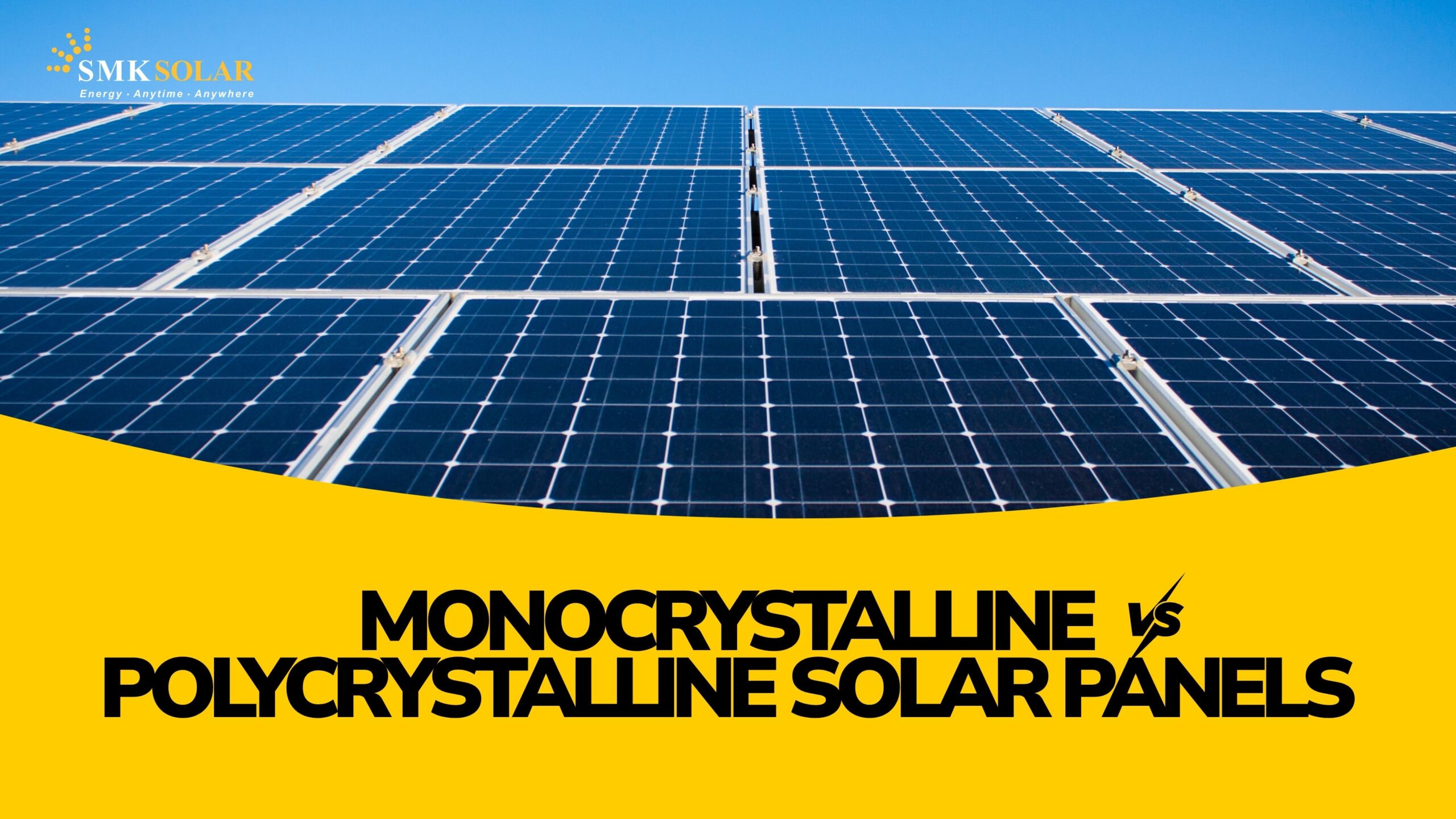
Monocrystalline solar panels are manufactured using solar cells made from a single crystal structure.
They are commonly recognizable by their darker appearance and are widely used in residential and commercial solar installations.
One of their key characteristics is their relatively high efficiency compared with some older panel technologies.
Polycrystalline solar panels are manufactured using multiple silicon crystal fragments.
They typically have a blueish appearance and have historically been used as a more economical alternative to monocrystalline panels.
Technology has continued to evolve, so the exact performance and pricing of individual panels can vary.
Monocrystalline panels have traditionally offered higher efficiency than conventional polycrystalline panels.
This can make them useful where available installation space is limited.
Monocrystalline panels generally have a darker appearance, while polycrystalline panels often have a blue appearance.
For some property owners, appearance may be an important consideration.
If two systems have different efficiency levels, the more efficient panels may require less physical space to achieve a particular power capacity.
Pricing varies according to manufacturer, panel capacity, technology, availability and market conditions.
The cheapest panel is not necessarily the lowest-cost solution over the lifetime of the system.
There is no single panel type that is appropriate for every property.
Your choice should consider:
Nigeria receives substantial solar resources, but the actual performance of a solar installation depends on local conditions and system design.
Your installer should consider the property’s location, roof orientation, shading and expected energy demand.
Buying panels without considering the inverter, batteries and other components can result in an unsuitable system.
A properly designed solar installation considers the entire energy system.
They have different characteristics. Monocrystalline panels generally offer higher efficiency, but the appropriate option depends on the specific project.
Higher-efficiency panels can be advantageous when roof space is limited.
Yes. The suitability depends on the system design, equipment availability and project requirements.
Yes. Manufacturer quality, specifications, warranty and product reliability should be considered.
SMK Solar can help assess your property and energy requirements before recommending a suitable solar panel configuration.
Share:
Step into any of our branches in Lagos, Kano, Benin, or Uyo to see our SMK technology in action and speak with our technical team.
Tell us what you need to power, and our engineers will design a customized SMK Solar solution tailored to your home or business.
Have questions or need advice? Reach out to our professional team and get fast, reliable assistance.
WhatsApp us